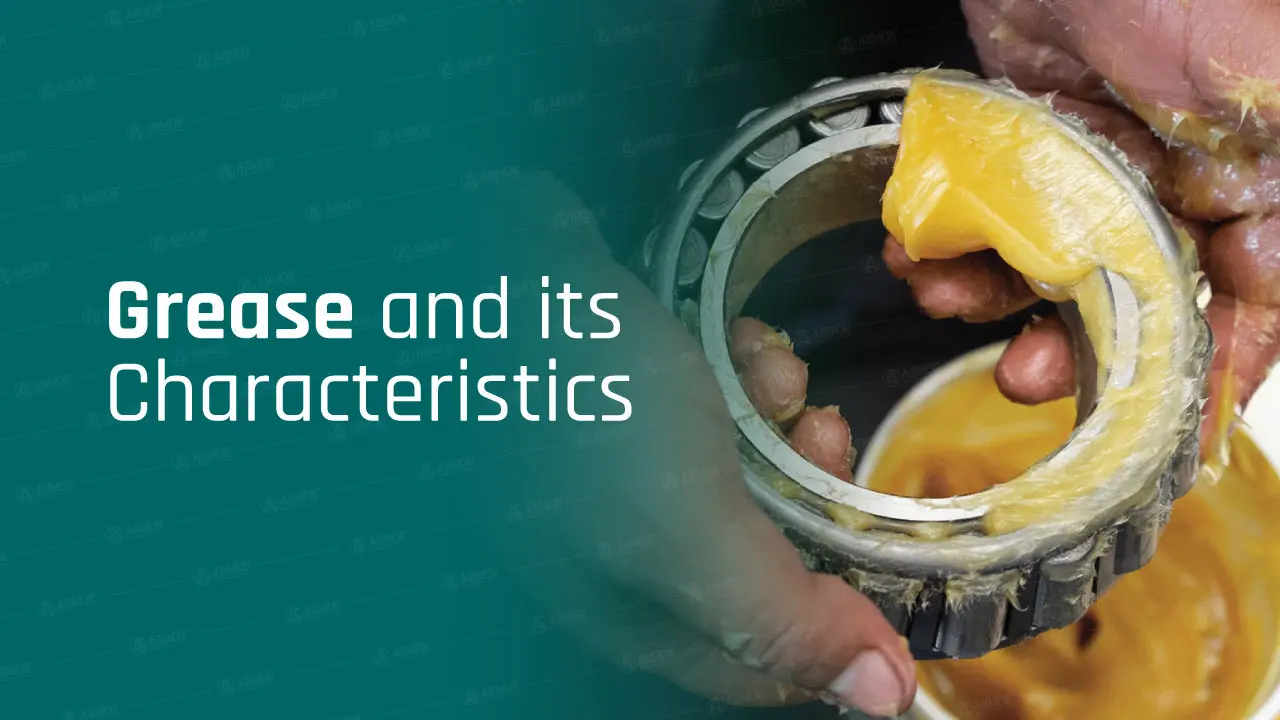
Grease is a semi-solid lubricant used to protect machinery and mechanical components from friction, wear, and corrosion. Unlike liquid lubricants, grease remains in place, providing long-term lubrication in environments where frequent reapplication is impractical.
It is widely used in industries such as automotive, manufacturing, construction, and marine, where extreme conditions demand a lubricant that resists water, contaminants, and high temperatures.
Grease consists of three main components: base oil, thickener, and additives. Base oil, usually mineral or synthetic, provides the fundamental lubricating properties. Thickeners give grease its consistency and acts like a sponge, holding the oil in place while allowing it to be released gradually. Additives enhance specific characteristics such as extreme pressure resistance, anti-corrosion properties, and oxidation stability.
The ratio of these components determines grease performance. Higher base oil content makes grease more fluid, while an increased thickener percentage results in a firmer consistency.
Read More: This informative blog post provides a brief Base Oil SN 150.
Grease is a semi-solid lubricant composed of a base oil, thickener, and additives. It provides long-lasting lubrication, resists leakage, and adheres well to surfaces, making it ideal for applications where liquid lubricants might not stay in place.
Both oil and grease serve as lubricants, but they differ in composition, application, and performance characteristics.
| Feature | Oil | Grease |
| State | Liquid | Semi-solid |
| Composition | Base oil + additives | Base oil + thickener + additives |
| Application | Moving parts, high-speed machinery | Bearings, joints, sealed components |
| Viscosity | Lower viscosity, flows easily | Higher viscosity, stays in place |
| Maintenance | Requires frequent reapplication | Offers longer-lasting lubrication |
| Contaminant Protection | Less effective in sealing out dirt and moisture | Forms a protective barrier against contaminants |
Grease is preferred over oil in many applications where long-lasting lubrication, better adhesion, and contamination resistance are crucial. Unlike oil, grease stays in place, making it ideal for components that operate under heavy loads or harsh conditions.
Grease consistency and performance vary based on thickener type, base oil viscosity, and additives. The National Lubrication and Grease Institute (NLGI) classifies greases into nine grades (000 to 6) based on their penetration value and consistency.
NLGI Consistency Grades and Their Properties
NLGI grades determine how grease performs in different applications based on consistency and penetration values. Softer greases, such as NLGI 000 to 1, offer better pumpability and are ideal for low-temperature environments and centralized lubrication systems.
Medium consistency greases, particularly NLGI 2 and 3, are widely used in automotive and industrial applications. Harder greases, ranging from NLGI 4 to 6, provide superior sealing properties.
| NLGI# | Penetration (Tenths of mm) | Consistency | Food Analogy |
| 000 | 445 – 475 | Fluid | Cooking Oil |
| 00 | 400 – 430 | Semi-Fluid | Applesauce |
| 0 | 355 – 385 | Very Soft | Brown Mustard |
| 1 | 310 – 340 | Soft | Tomato Paste |
| 2 | 265 – 295 | "Normal" Grease | Peanut Butter |
| 3 | 220 – 250 | Firm | Vegetable Shortening |
| 4 | 175 – 205 | Very Firm | Frozen Yogurt |
| 5 | 130 – 160 | Hard | Smooth Pâté |
| 6 | 85 – 115 | Very Hard | Cheddar Cheese |
Learn about lubricant additives, purpose, types, functions and benefits in this informative blog post.
Standard Classification and Specification of Automotive Service Greases (ASTM D4950) defines performance categories for chassis and wheel-bearing greases:
Grease formulations vary based on their thickener type, base oil, and additives. Each type serves specific applications depending on operating conditions, load capacity, and temperature resistance.
A versatile, high-performance grease made with lithium soap thickener and mineral or synthetic base oil. It is widely used in automotive, industrial, and household applications.
| Lithium Grease | |
| Characteristics | Applications |
| High-temperature resistance (up to 130–150°C) | Bearings and bushings in industrial equipment |
| Excellent water resistance | Conveyor systems and assembly lines |
| Good mechanical stability | Electric motors and mechanical components |
| Multipurpose application | Agricultural equipment for long-term lubrication |
A water-resistant grease made with calcium-based thickener, mainly used in marine, agricultural, and industrial applications.
| Calcium Grease | |
| Characteristics | Applications |
| Superior water resistance | Marine equipment (rudders, winches, propeller shafts) |
| Good rust and corrosion protection | Farm machinery operating in muddy conditions |
| Moderate temperature tolerance (up to 90°C) | Food processing equipment (non-toxic variants available) |
| Not suitable for high-speed applications | Construction machinery exposed to moisture |
An advanced version of lithium grease with higher temperature tolerance and extreme pressure (EP) properties. Used in automotive, heavy machinery, and industrial bearings.
| Lithium Complex Grease | |
| Characteristics | Applications |
| High-temperature resistance (up to 260°C) | Steel mills and mining equipment |
| Excellent load-bearing capacity | Heavy-duty bearings in industrial machinery |
| Good water resistance | Automotive wheel bearings and suspension components |
| Multipurpose, ideal for heavy-duty applications | Hydraulic presses and forging machines |
A non-soap grease commonly used in electric motors, industrial equipment, and long-life applications.
| Polyurea Grease | |
| Characteristics | Applications |
| Superior high-temperature performance | Electric motor bearings in HVAC systems |
| Long service life | Industrial pumps and compressors |
| Good oxidation stability | Textile and paper manufacturing machines |
| Not compatible with other grease types | Robotics and automation systems |
A high-performance grease designed for food processing, marine, and high-temperature applications.
| Aluminum Complex Grease | |
| Characteristics | Applications |
| High-temperature resistance (up to 230°C) | Food and beverage processing equipment (NSF H1 variants) |
| Excellent water resistance | Bakery ovens and industrial furnaces |
| Good adhesion properties | Marine components and ship maintenance |
| Suitable for food-grade applications | Pharmaceutical and cosmetics machinery |
A soap-based grease with high mechanical stability, mainly used in wheel bearings and industrial machinery.
| Sodium Grease | |
| Characteristics | Applications |
| Good mechanical stability | Wheel bearings in industrial vehicles |
| High dropping point | Gearboxes in machinery and power plants |
| Poor water resistance | Railway components and track lubrication |
| Limited corrosion protection | Steel rolling mills and turbines |
A non-melting grease designed for extreme high-temperature applications such as kilns and furnaces.
| Bentonite (Clay-Based) Grease | |
| Characteristics | Applications |
| Withstands extreme heat (above 250°C) | Kilns and foundries |
| Non-melting properties | Glass manufacturing plants |
| Good shear stability | Steel forging and metal casting equipment |
| Poor water resistance | Aircraft engine components |
A heavy-duty grease containing molybdenum disulfide, ideal for high-load and shock-load applications.
| Molybdenum Disulfide (Moly) Grease | |
| Characteristics | Applications |
| Superior load-bearing capability | Excavators, bulldozers, and loaders |
| Reduces friction and wear | Mining drills and crushers |
| Performs well under extreme pressure | Railway couplings and suspension systems |
| Common in mining, construction, and heavy-duty machinery | Off-road and military vehicle joints |
Understanding grease and its characteristics is essential for machinery maintenance and smooth operation. Whether you're dealing with high temperatures or heavy loads, this quick guide will help you select the right grease for your specialized application.
For high-grade grease solutions, Armor Lubricants offer greases at the best prices in UAE designed to meet diverse automotive and industrial applications. Explore the best quality grease products and find the perfect grease to keep your machinery running smoothly.