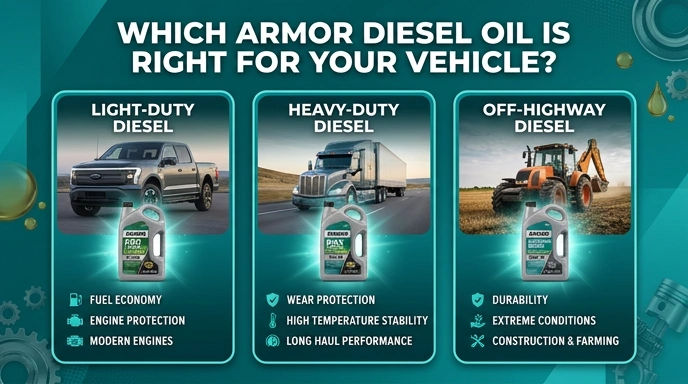
Selecting the precise lubricant for your diesel engine extends beyond simple brand loyalty. It requires a technical understanding of viscosity grades, API service categories, and OEM specifications. Armor Lubricants engineers fluids to meet rigorous demands, but matching the formulation to your operational profile is critical for maintaining engine integrity.
Operators must analyze the specific thermal conditions, load factors, and emission systems present in their equipment. A mismatch in lubrication can lead to accelerated wear, increased oil consumption, or catastrophic failure of after-treatment systems like Diesel Particulate Filters (DPF). The right choice optimizes fleet uptime and fuel efficiency.
Viscosity remains the primary metric for lubricant selection. It dictates the fluid's resistance to flow at specific temperatures. Modern diesel engines require oils that maintain a protective film under high heat while remaining fluid enough to circulate immediately during cold starts. This balance prevents metal-to-metal contact during the most critical moments of engine operation.
Understanding the numbers on the bottle is essential for protecting tight tolerance components. The "W" rating indicates winter flow properties, while the second number represents viscosity at operating temperature. Choosing the incorrect grade can starve the valvetrain of lubrication or cause excessive drag that ruins fuel economy ratings.
Operators working in climates with extreme temperature fluctuations often find 5w40 synthetic diesel oil to be the superior choice. This formulation offers a low pour point, ensuring rapid oil pressure build-up during sub-zero starts. Unlike conventional oils, the synthetic base stocks resist thickening in the cold.
Once the engine reaches operating temperature, the 40-weight rating provides a robust film strength. This protects bearings and cylinder liners under heavy loads. It is an ideal all-season solution for fleets that traverse varied geographical regions, eliminating the need for seasonal oil changes based solely on ambient weather shifts.
For engines operating primarily in hotter climates or under constant heavy hauling, 15 40 full synthetic diesel oil is a staple class. This grade offers exceptional shear stability. High-torque applications tend to shear viscosity modifiers in lesser oils, causing the fluid to thin out dangerously during operation.
A full synthetic 15W-40 maintains its structural integrity longer than mineral-based equivalents. It resists thermal breakdown and oxidation, which keeps the Total Base Number (TBN) stable. This retention of alkalinity is vital for neutralizing acids formed during combustion, thereby preventing corrosion of internal engine components over extended drain intervals.
The push for improved fuel economy in the logistics sector has driven the development of lower viscosity fluids. Manufacturers are designing engines with tighter clearances that tolerate thinner oils without sacrificing protection. Switching to these advanced formulations can result in measurable reductions in parasitic drag on the crankshaft.
Reducing internal friction directly correlates to lower fuel consumption. For fleet managers overseeing hundreds of assets, a fractional increase in Miles Per Gallon translates to significant operational savings. However, these oils must still pass rigorous wear tests to ensure durability is not compromised for the sake of efficiency.
Newer diesel engines often specify 5w30 full synthetic diesel oil to meet stringent efficiency standards. This fluid flows faster through the gallery, carrying heat away from pistons and turbochargers more effectively than thicker grades. It is particularly effective in stop-and-go driving conditions where heat management is a challenge.
This viscosity grade is often formulated with advanced additive packages compatible with modern emission control systems. It minimizes ash deposits in the DPF while ensuring the durability of the engine. Always verify that a 5W-30 product meets the specific OEM approval for your engine generation before application.
Heavy-duty trucking engines have distinct lubrication requirements compared to light-duty pickups. These powerplants operate at extreme pressures and require oils with high soot-dispersancy capabilities. Soot accumulation can thicken oil and cause abrasive wear on the camshaft and rocker arms if the fluid cannot suspend the particles effectively.
Each engine manufacturer releases proprietary standards that oil must meet. Ignoring these specifications voids warranties and risks mechanical failure. Using a generic diesel oil in a specialized heavy-duty engine is a gamble that professional operators should never take.
The Detroit Diesel DD15 is a workhorse in the Class 8 trucking world. The correct dd15 engine oil type is typically a low-viscosity formulation meeting DFS 93K222 or DFS 93K218 specifications. These standards ensure the oil can handle the thermal stress of the engine’s asymmetric turbocharger system.
Operators typically utilize 10W-30 or 5W-30 in newer DD15 models to maximize fuel economy. Using the correct specification ensures compatibility with the engine's long drain intervals. It also guarantees that the oil formulation limits ash buildup, preserving the service life of the rigorous after-treatment system found on Freightliner Cascadia trucks.
Owners of the 2006 Dodge Ram with the 5.9L Cummins usually rely on CJ-4 or CK-4 designated oils. While newer trucks use lighter fluids, this generation prefers the protection of a 15W-40 or 5W-40. One critical maintenance aspect is the 06 cummins oil capacity, which is approximately 12 quarts or 3 gallons with a filter change.
Overfilling or underfilling this engine can lead to aeration or starvation. The 5.9L engine is known for its reliability, but it demands oil with high zinc and phosphorus levels to protect the valvetrain. Ensuring the correct volume and specification keeps the turbo bearings lubricated preventing premature failure.
Agricultural machinery demands a different class of lubrication strategy. Tractors often utilize a common reservoir for transmission, hydraulic, and wet brake systems. This requires a Universal Tractor Transmission Oil (UTTO) rather than standard engine oil, though the engine itself still requires high-grade diesel protection.
Using the wrong fluid in a hydraulic system can destroy seals and cause pump cavitation. The fluid must be non-foaming and possess high water tolerance, as agricultural equipment is frequently exposed to humidity and condensation. Proper fluid selection ensures precise hydraulic response and smooth power take-off (PTO) operation.
For compact tractors, specifically regarding john deere 1025r hydraulic oil, operators must use a fluid that meets J20D or J20C specifications usually known as Hy-Gard. This fluid manages the hydrostatic transmission functions and implements hydraulics simultaneously, requiring specific friction modifiers for wet clutches.
Standard hydraulic oil lacks the additives necessary to prevent chatter in the hydrostatic drive system. The correct fluid maintains viscosity across a wide temperature range, preventing sluggish operation in winter and thinning in summer. Always check the viscosity index to match the ambient operating temperature of your farm or job site.
Even the highest quality synthetic oil cannot protect an engine if the filtration system is compromised. As oil circulates, it suspends contaminants like silica, metal shavings, and soot. The filter must capture these particles without restricting flow to vital engine components.
Modern filters use synthetic media to trap smaller microns of debris compared to cellulose filters. This is necessary for extended drain intervals where oil is kept in service for tens of thousands of miles. A clogged filter will trigger the bypass valve, sending dirty oil back into the engine, which accelerates wear instantly.
When servicing a Detroit Diesel engine, the choice of freightliner cascadia oil filter is paramount. These filters must handle high flow rates while removing particles as small as 20 microns. Using an aftermarket filter with a lower bust pressure rating can lead to structural failure under the high oil pressures seen during cold starts.
OEM-approved filters are designed to work in tandem with the specified drain intervals of the DD15 or DD13 engines. They possess the capacity to hold the significant volume of soot generated by EGR systems. Ensuring the filter matches the service life of specific synthetic oils prevents premature plugging and pressure drops.
Identifying the best oil for diesel engines depends on the balance between protection, longevity, and cost-efficiency. There is no single universal "best" oil; rather, there is an optimal formulation for specific applications. High-mileage highway haulers have different needs than stationary generators or construction equipment operating in dust.
Premium diesel oils distinguish themselves through robust additive packages. These include detergents that keep pistons clean and dispersants that prevent sludge. The base oil quality determines the oxidation resistance, which is the primary factor in how long the oil can remain in the engine before turning acidic.
Shear stability refers to a lubricant's ability to resist viscosity loss under mechanical stress. In diesel engines, oil is squeezed through tight bearing clearances and gear trains, which can tear lubricant molecules apart. If the oil shears down a grade, a 15W-40 might effectively become a 10W-30, reducing protection.
High-quality synthetic oils use stable polymers that resist this mechanical shearing. This ensures that the protective film thickness remains constant throughout the entire service interval. Mechanics analyzing used oil analysis (UOA) reports look for shear stability as a key indicator of oil health and engine condition.
The American Petroleum Institute (API) categorizes oil performance standards. Understanding the shift from CJ-4 to CK-4 and FA-4 is vital for mixed-fleet managers. These categories define the limits for chemical properties like sulfated ash, phosphorus, and sulfur (SAPS), which impact emission systems.
These standards are rigorous chemical benchmarks. They ensure that the oil can handle hotter combustion temperatures found in modern engines. Using an obsolete API category in a Tier 4 Final engine can damage the catalytic reduction systems and lead to regulatory non-compliance fines.
CK-4 oils are designed as direct replacements for legacy fluids. They offer backward compatibility for older engines while providing better oxidation stability. This makes CK-4 the safest choice for mixed fleets containing both new and old trucks requiring high-temperature shear protection.
FA-4 oils are distinct formulations designed specifically for newer engines optimized for fuel economy. They have lower High-Temperature High-Shear (HTHS) viscosity. Do not use FA-4 oils in older engines unless explicitly approved by the manufacturer, as the lower viscosity may not provide adequate oil pressure for worn components.
Diesel combustion naturally produces soot, a carbon by-product that turns oil black. If soot particles agglomerate, they form abrasive sludge that wears down the valvetrain. High-quality Armor diesel oil utilizes advanced dispersant technology to keep these particles suspended on a microscopic level.
By preventing soot from clumping, the oil remains fluid and can be effectively filtered. This capability is particularly important for engines with Exhaust Gas Recirculation (EGR), which reintroduces exhaust soot back into the combustion chamber. Superior soot control extends the life of both the oil and the engine.