Most trucks and off-road vehicles roll off the assembly line with a stamped steel sheet metal cover bolted to the rear axle. While cost-effective for manufacturers, this component often serves as the weak link in the drivetrain. It acts merely as a bowl to hold fluid, offering minimal benefits regarding performance or longevity.
For drivers pushing their vehicles through towing, hauling, or trail riding, the stock equipment falls short. The thin metal provides little protection against impact and offers zero thermal advantages. Upgrading to a specialized unit becomes a necessity rather than an accessory for longevity.
Heat generation and lubricant breakdown create the primary enemies of differential gears. When a vehicle works hard, the friction between the ring and pinion gears generates immense thermal energy. A standard cover traps this heat, leading to rapid fluid oxidation.
Modern aftermarket solutions address these thermal inefficiencies directly. By utilizing materials with high thermal conductivity and engineering specific flow patterns, these upgrades actively extend the life of your axle components. The investment protects the expensive internals from premature failure.
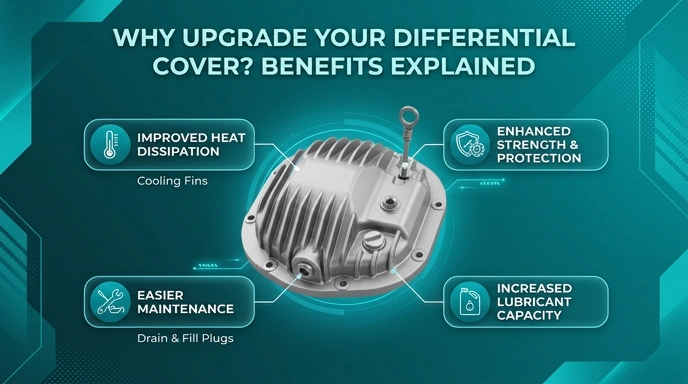
Heat dissipation remains the primary argument for replacing a factory unit. A standard stamped steel cover acts as an insulator, keeping heat locked inside the housing. This retention causes gear oil to exceed its operating temperature range, leading to viscosity breakdown.
Aftermarket options like the Banks rear diff cover utilize cast aluminum construction. Aluminum possesses superior thermal conductivity compared to steel. This material property allows heat to transfer from the fluid to the outside air much more efficiently.
The design of the exterior surface plays a massive role in cooling. Manufacturers integrate external cooling fins into the casting. These fins drastically increase the surface area exposed to passing airflow. This design mimics the function of an air-cooled engine cylinder head.
Advanced designs utilize the airflow beneath the truck to strip heat away from the housing. Some units, such as the Banks differential cover, feature air scoops or directed vanes. These catch the air moving past the axle and force it through the cooling fins.
This forced convection is critical when towing heavy loads up steep grades. A Ram 2500 diff cover equipped with these features can drop fluid temperatures by significantly more degrees than a passive flat-back cover. Keeping fluids cool preserves their lubricating properties.
Cooling must happen internally as well as externally. The internal geometry of high-end covers, such as those intended for a Dana 80 rear differential cover, often includes internal fins or heat sinks. These submerged structures grab heat from the oil and conduct it to the outer walk.
Without internal surface area, the fluid acts as an insulator against the cover wall. By breaking up the boundary layer of the oil, the cover ensures that the hottest fluid constantly cycles against the cooling aluminum surface.
Fluid dynamics inside a differential housing are chaotic. As the ring gear spins, it slings oil with tremendous force. In a poorly designed housing, this creates aeration and foam. Foamy oil contains air bubbles, which are terrible at lubricating high-pressure gear teeth.
Performance units are shaped to direct this flow. A Banks diff cover usually features a curved internal profile that guides the flung oil back to the pinion bearing. This ensures critical components maximize lubrication without churning air into the mixture.
Proper flow management also reduces parasitic loss. If the gears have to push through a wall of unguided, turbulent oil, it robs horsepower. Streamlined internal housings allow for efficient lubrication that coats the gears without creating unnecessary drag.
Foaming leads to heat and component wear. When air mixes with gear oil, the fluid cannot maintain the film strength required to separate metal surfaces. This results in metal-on-metal contact under load.
Engineering a cover to channel oil smoothly prevents the "whipping" effect. This is particularly vital in high-speed applications or heavy-duty axles like the AAM 11.5 differential cover found on heavy-duty diesel trucks.
Volume acts as a buffer against thermal spikes. A stock cover typically holds only enough fluid to meet the bare minimum requirements. Aftermarket cast covers usually increase this capacity significantly, sometimes doubling the fluid volume.
A larger volume of oil takes longer to heat up. This thermal mass is advantageous during short bursts of high-intensity driving, such as towing a trailer up a mountain pass or navigating a difficult off-road obstacle.
More fluid also means a higher concentration of additives. Gear oil contains friction modifiers and anti-wear packages that deplete over time. By running a Mag Hytec differential cover with increased capacity, you effectively increase the amount of available additives.
This does not eliminate the need for maintenance, but it adds a safety margin. The oil remains stable for longer periods, provided it is not subjected to contamination. For fleets running an F250 rear differential cover, this can translate to reduced downtime.
Axle housings are not perfectly rigid. Under extreme torque, the housing can flex. This deflection causes the bearing caps to shift slightly, altering the contact patch between the ring and pinion gears. This misalignment accelerates wear and can break gear teeth.
A thick, cast aluminum or nodular iron cover acts as a girdle for the housing. By bolting a rigid structure to the opening, you increase the torsional stiffness of the entire axle assembly. This is crucial for high-torque applications involving a Dana 60 diff cover or GM 14 bolt differential cover.
Some competition-level covers include load bolts. These are bolts that thread through the cover and press against the main bearing caps. This feature physically prevents the caps from deflecting rearward under load.
You will often see this on a performance Ford 8.8 differential cover or units designed for drag racing. It essentially bridges the gap between the cover and the differential carrier, creating a solid unit that resists distortion.
Servicing a stock differential is a messy, frustrating task. It typically involves unbolting the entire cover, prying it loose, and dealing with a gush of oil. Reinstallation requires meticulous cleaning of the mating surface and applying new RTV silicone.
Aftermarket manufacturers prioritize serviceability. Almost every upgraded unit, from a PPE differential cover to an ARB model, includes a dedicated drain plug. This allows for fluid changes without removing the cover itself.
Wear is inevitable in any mechanical system. Small metal shadings from the gears and clutch packs circulate in the oil. A magnetic drain plug captures these ferrous particles, preventing them from being ground back into the bearings.
High-quality units like the Banks power diff cover utilize powerful rare-earth magnets. Checking this magnet during a fluid change provides an instant health report on your gears. A fuzzy magnet is normal; large chunks indicate impending failure.
Checking fluid levels on a stock axle involves removing a fill plug and sticking a finger inside. Many aftermarket covers, such as those from Mag Hytec, incorporate a dipstick or a sight glass. This allows for instant visual verification of fluid level and condition.
For a reliable tow rig utilizing a Sterling 10.5 differential cover, being able to check the oil level at a fuel stop adds peace of mind. It ensures that a slow leak does not turn into a catastrophic dry-bearing failure.
The material of the cover dictates its primary benefit. Cast aluminum is the king of heat dissipation. It is lightweight and sheds heat rapidly, making it ideal for towing vehicles like the Silverado 1500 or Ram 2500.
Nodular iron or heavy-gauge welded steel is preferred for rock crawling. A Jeep differential cover needs to withstand direct impacts with boulders. While aluminum cools better, it can crack under hard impact. Iron deforms or resists the blow entirely.
Aluminum covers like the AFE differential cover offer the best balance for street and towing performance. They are rigid enough to strengthen the housing and offer the best cooling properties. They are highly resistant to corrosion, keeping the undercarriage looking clean.
These covers are often powder-coated or finished naturally. A raw aluminum finish radiates heat effectively, though black powder coat is often used for aesthetic protection. Brands like Banks focus heavily on the thermodynamics of these aluminum castings.
For a Dana 44 differential cover on a trail rig, durability takes precedence over cooling. Rock crawlers move slowly, generating less heat but facing higher impact risks. A Solid differential cover made from nodular iron can take a beating that would shatter aluminum.
Welded steel plate covers, often called "crusher" covers, are also popular in the 4x4 community. These are fabricated from thick steel plate and offer immense impact protection for the ring gear. They are less expensive than cast iron but offer zero cooling benefits.
Identifying the correct axle is the first step in upgrading. A customized setup on a Jeep might require a Dana 30 diff cover up front and a Dana 44 in the rear. Heavy-duty trucks often switch axles based on the engine package, such as the difference between a Sterling 10.25 and a Sterling 10.5.
Owners of GM trucks must distinguish between the varying bolt patterns. A GM 10 bolt diff cover is not interchangeable with a 12 bolt or 14 bolt. Counting the bolts is the most reliable method of identification before ordering.
Trucks like the Ford F250 or Ram 3500 put massive stress on rear ends. The Banks diff cover Ram 2500 models are specifically tuned for the AAM axles found under these trucks. The emphasis here is entirely on fluid life extension through cooling.
When towing near maximum GCVW, the rear differential can exceed 250 degrees Fahrenheit. At these temperatures, conventional gear oil begins to degrade rapidly. An upgrade here is an investment in the longevity of the truck's powertrain.
Clearance is a major factor for off-roaders. Some high-capacity covers are bulky. A large Dana 60 rear differential cover might interfere with the track bar or gas tank on a modified Jeep Wrangler. It is vital to check clearance at full suspension compression.
Specifically, the front suspension creates tight packaging. A front diff cover on a Ram 2500 or Jeep needs to clear the tie rod linkage. Manufacturers like ARB design ‘low profile’ versions of their covers to accommodate steering components.
While function is paramount, form plays a role. A rusted, leaking stock cover looks neglected. Replacing it with a powder-coated Yukon differential cover improves the visual appeal of the vehicle’s undercarriage. This is relevant for lifted trucks where the axle is visible.
finishes range from raw machined aluminum to black texture and even chrome. A Chrome differential cover was popular in the muscle car era, but modern trends favor durable powder coats that resist road salts and debris.
Many enthusiasts choose covers that match their build theme. Custom differential covers can be milled with logos or painted to match the suspension components. For show trucks, the rear axle is a centerpiece, and a generic stamped steel cover ruins the look.
Products like the Poison Spyder differential cover offer a rugged, aggressive aesthetic that signals the vehicle is built for hard use. The branding often serves as a badge of honor within the enthusiast community.
A leak-free installation depends on the sealing surface. Traditional paper gaskets are prone to wicking oil over time. Most modern installers prefer a high-quality RTV silicone or a reusable LubeLocker gasket.
Reusable gaskets are a significant upgrade. They feature an elastomer bead printed on a steel core. This allows the cover to be removed and reinstalled without the time-consuming process of scraping old silicone. This pairs perfectly with a high-end PPE rear diff cover.
Even a heavy-duty cast cover can warp if tightened incorrectly. Bolts should be tightened in a star pattern to ensure even clamping pressure. This is especially true for covers with wide bolt spacing, like the GM 14 bolt differential cover.
Over-tightening can crack a cast aluminum flange. Always use a torque wrench and adhere to the manufacturer's specifications. Using the supplied hardware is also critical, as the flange thickness of an aftermarket cover is greater than stock.
The cost of a differential rebuild is substantial. Ring and pinion gear sets, installation kits, and specialized labor can run into the thousands. Compared to this expense, a high-quality cover is a minor insurance premium.
By extending the fluid life and preventing overheating, the cover pays for itself over the life of the vehicle. This is particularly true for older vehicles, such as a 2007 Ford F150, where preserving the original drivetrain components is more cost-effective than replacement.
Some owners worry about voiding warranties. Generally, the Magnuson-Moss Warranty Act protects consumers who use aftermarket parts like a Ford Performance rear diff cover, provided the part did not cause the failure. In fact, many dealerships sell these upgrades directly.
Direct-fit parts from reputable brands like Banks or Spicer are designed to meet or exceed OEM specifications. They fit the 2019 Ram 1500 differential cover bolt pattern exactly, requiring no modifications that could be flagged by a service advisor.
The market is flooded with options. Banks Power is renowned for its research into fluid dynamics. Their covers are tested in wind tunnels and on dynos. If cooling is the priority, a Banks differential cover is often the benchmark.
Mag-Hytec set the standard for high-capacity deep pans. Their dipstick design and o-ring sealing systems are top-tier. They are a favorite among the diesel towing crowd for the Dana 70 and Dana 80 axles.
ARB provides a unique balance of strength and utility. Their red covers are iconic in the 4x4 world. They feature a unique dipstick and cross-bracing structure that handles the abuse of the Australian Outback.
Not every build requires a top-tier engineered part. Brands like G2 or generic cast covers offer increased strength over stock without the high price tag of specific fluid engineering. For a daily driver 2015 F150 differential cover, a simple cast aluminum replacement is sufficient.
Ensure that even lower-cost options include magnetic drain plugs. This simple feature is worth the upgrade cost alone, facilitating easier DIY maintenance for the vehicle owner.
The differential works harder than almost any other component in the driveline. It translates engine power into forward motion while carrying the weight of the vehicle. Neglecting it is a recipe for being stranded.
Whether dragging a fifth-wheel trailer with a Ram 3500 or crawling rocks in a Jeep Gladiator, the stock steel cover is a liability. Upgrading to a purpose-built unit improves cooling, lubrication, protection, and serviceability.
From the visual appeal of a polished Yukon diff cover to the scientific airflow management of a Banks unit, the market offers a solution for every application. It serves as a fundamental step in building a reliable, bulletproof vehicle capable of handling environments far beyond the factory test track.