Engine knocking signifies a fundamental disruption in the combustion process or a structural failure within the power unit. Ignoring these auditory warnings invariably leads to catastrophic engine failure. Understanding the specific acoustics helps distinguish between benign thermal expansion and critical component disintegration.
Professionals categorize these sounds into two primary groups. The first is combustion-related abnormal events, often described as pinging or detonation. The second is mechanical interference, resulting from excessive clearances in the rotating assembly. Accurate diagnosis requires identifying specific operating conditions like RPM and load.
Combustion anomalies and mechanical wear produce distinct acoustic signatures. Detonation creates a metallic pinging or rattling noise, often resembling marbles shaking in a tin can. This sound usually manifests under load or high cylinder pressures. It indicates unstable flame propagation.
Mechanical failure produces a deep, rhythmic thud synonymous with rod knock. This sound correlates directly with engine speed. As the crankshaft rotation increases, the frequency of the impact intensifies. This represents physical contact between heavy metal components due to lubricant film failure.
Spark knock, or pinging, occurs when the air-fuel mixture ignites spontaneously creates multiple flame fronts. These distinct flame fronts collide, causing a massive spike in cylinder pressure. This pressure wave strikes the piston creates the audible metallic ping. This is often confused with mechanical tapping.
Engine pinging is destructive to piston ring lands and rod bearings over time. Continued exposure to these shockwaves erodes the boundary layer of gasses protecting the piston crown. This leads to thermal damage and eventual melting of internal aluminum components.
A true rod know indicates excessive clearance at the big end of the connecting rod. The hydrodynamic oil wedge that normally separates the bearing from the crankshaft journal has collapsed. The resulting sound is a heavy, consistent hammering from the bottom end of the block.
This knocking sound on acceleration creates a distinct, hollow tone. Unlike pinging, this noise does not usually dissipate with higher octane fuel. It signifies permanent damage requiring an engine teardown. Immediate cessation of engine operation is necessary to save the crankshaft.
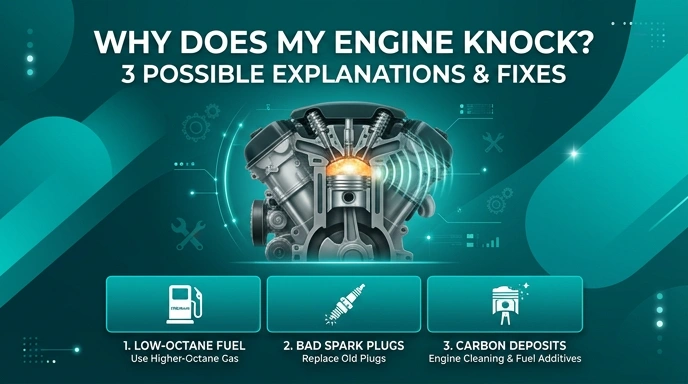
The octane rating of gasoline serves as a measure of the fuel's resistance to detonation. It does not represent energy content but rather stability under pressure. Using fuel with an insufficient Anti-Knock Index (AKI) for a high-compression engine invites pre-detonation events.
Modern Engine Control Units (ECUs) utilize knock sensors to detect these events. When the sensor registers a specific frequency of vibration, the ECU retards ignition timing. This protects the engine but results in reduced power output and sluggish throttle response.
High-performance engines utilize higher compression ratios to extract maximum thermal efficiency. Greater compression heats the intake charge significantly. If the fuel ignites solely from this heat before the spark plug fires, the engine knocks. Higher octane fuel withstands this heat without auto-igniting.
When an engine encounters a load at low RPM, cylinder pressures peak. High-gear, low-speed maneuvers put the engine is the danger zone for detonation. Using premium fuel ensures the flame front propagates strictly from the spark plug ignition point outward.
A lean mixture contains an excess of air relative to fuel. Lean mixtures burn hotter and faster than stoichiometric or rich ratios. This excess heat elevates combustion chamber temperatures, promoting hot spots that trigger detonation and engine pinging.
Vacuum leaks or failing fuel injectors are common culprits. Unmetered air entering the manifold bypasses the Mass Air Flow sensor. The ECU delivers fuel based on incorrect air data, resulting in a lean condition that causes a knocking noise on acceleration.
Carbon buildup on piston crowns and cylinder heads artificially increases the compression ratio. These deposits occupy physical volume within the combustion chamber. An engine designed for 10:1 compression may effectively operate at 11:1 due to heavy carbon accumulation.
Furthermore, carbon creates thermal insulation. It retains heat from previous combustion cycles. These glowing embers act as secondary ignition sources, igniting the incoming charge prematurely. This creates a tapping in the engine that persists until the carbon is removed.
Pre-ignition differs distinctly from detonation, though they often occur sequentially. Pre-ignition involves the mixture igniting before the spark plug fires. This is the most lethal form of abnormal combustion. The piston is still moving upward on the compression stroke when the force of combustion strikes it.
This counter-force tries to reverse the rotation of the engine. The stress placed on connecting rods and bearings during pre-ignition is immense. It can bend rods or crack ring lands in a single event. It is often described as a knocking sound when accelerating at low speed.
Installing spark plugs with an incorrect heat range induces pre-ignition. A plug that is "too hot" cannot dissipate combustion heat into the cylinder head fast enough. The ceramic insulator and electrode tip remain red hot, acting as a glow plug.
This residual heat ignites the fuel immediately upon injection or intake. Manufacturers specify heat ranges precisely to balance self-cleaning properties with heat dissipation. Deviating from this spec in modified engines requires careful thermal analysis.
Localized overheating within the water jacket creates hot spots in the cylinder head. If coolant flow is restricted around a specific cylinder, the metal temperature spikes. This heat transfers to the combustion chamber surface, causing the air-fuel mixture to ignite upon contact.
Old coolant loses its effectiveness and anti-corrosive properties. Sediment buildup acts as an insulator, preventing heat transfer from the metal to the liquid. Ensuring the cooling system functions efficiently is vital to stop engine knock caused by thermal stress.
When the knocking sound comes from the rotating assembly, chemical fixes are irrelevant. Determining how to fix a knocking engine rod usually involves machining or replacement. Visual inspection of the oil often reveals glittery metallic particulate, confirming bearing failure.
Bearings are sacrificial components designed to protect the crankshaft. Once the babbitt material wears through to the copper or steel backing, friction increases exponentially. The gap widens, allowing the rod to hammer against the crank journal, causing the classic motor knocking sound.
Oil pressure maintains the hydrodynamic film that prevents metal-to-metal contact. If the oil pump is weak or the pickup tube is obstructed, pressure drops. Without adequate pressure, the cushion collapses, and the engine knocks when I accelerate due to physical impact.
Using oil with incorrect viscosity affects film strength. In high-performance applications, shear stability is crucial. If the oil thins out excessively under heat, it cannot support the load on the bearings. This leads to spun bearings and severe bottom-end knock.
Piston slap produces a hollow, clicking noise, particularly when the engine is cold. It occurs when the clearance between the piston skirt and the cylinder wall is excessive. The piston rocks in the bore rather than tracking straight up and down.
This noise often diminishes as the engine warms up. The aluminum piston expands faster than the iron sleeve, tightening the tolerance. However, severe piston slap that persists at operating temperature indicates collapsed skirts or excessive bore wear requiring a re-sleeve.
Modern vehicles provide data streams that help visualize knocking events. Feedback knock correction is a reactive parameter. The ECU detects noise via the microphone-like knock sensor and immediately pulls timing to save the motor. Monitoring this data helps pinpoint the cause.
A feedback knock value usually appears as a negative number on a diagnostic tool. Small corrections are normal during shifts or abrupt throttle imputs. Consistently high negative values under load indicate a genuine mechanical or fuel-related issue that needs attention.
The ECU learns from persistent knocking events. If the engine consistently knocks at 3000 RPM and 50% load, the computer stores a timing reduction for that specific cell. This is Fine Learning Knock Correction (FLKC). It is a proactive measure derived from past data.
Analyzing FLKC tables helps mechanics identify specific load ranges causing trouble. If the ECU is constantly pulling timing in the high-load columns, it suggests fuel quality issues or mechanical noise triggering the sensors falsely. This data creates a roadmap for diagnosis.
Knock sensors are piezoelectric microphones tuned to specific frequencies. They cannot visually see the combustion. Consequently, loose brackets, rattling exhaust heat shields, or solid transmission mounts can generate vibrations that mimic the frequency of engine knock.
This phenomenon is known as false knock or phantom knock. The ECU pulls timing unnecessarily, robbing the engine of power. Mechanics verify this by checking for loose ancillaries near the block or desensitizing the sensors via tuning software if aftermarket mounts are installed.
Resolving an engine knock starts with isolation. Determine if the noise tracks with RPM or is intermittent. Determine if it occurs under load or at idle. A knocking sound in the engine requires a systematic approach, starting with the least invasive solutions.
For pinging issues, immediately verify the fuel grade. If the tank contains low-octane gasoline, refrain from high-throttle inputs until it is diluted with premium fuel. Adding an octane booster can serve as a temporary band-aid to mitigate the risk.
If carbon deposits are suspected, chemical decarbonization is effective. Direct injection engines are prone to valve deposits that fuel additives cannot reach. In these cases, media blasting the intake valves prevents the turbulence that causes poor mixture homogeneity.
For port-injected engines, fuel system cleaners with Polyether Amine (PEA) break down stubborn carbon on pistons. Run a high-concentration cleaner through a low tank of gas. This can resolve hot spots and stop the tapping in the engine associated with pre-ignition.
A ticking or tapping sound from the top of the engine often points to hydraulic lifters. These components rely on oil pressure to maintain zero valve lash. If they collapse or become clogged with sludge, they fail to take up the slack.
This creates a distinct tapping that varies with RPM but is lighter than rod knock. Changing the oil and using a high-detergent additive can free stuck plungers. If the noise persists, the lifters require physical replacement to restore proper valve train geometry.
Low Speed Pre-Ignition (LSPI) is prevalent in small-displacement turbocharged engines. It occurs at low speeds with high torque requests. The pressure spikes are extreme and often result in instant engine failure. Oil composition plays a significant role here.
Use motor oils specifically formulated to combat LSPI (API SP or ILSAC GF-6 standards). These oils reduce calcium-based detergents, which are known precursors to LSPI events. Avoid lugging the engine in high gears to manually prevent the conditions where LSPI thrives.
A common myth is that an oil additive for knocking engine problems will cure a spun bearing. High-viscosity additives can dampen the sound of a rod knock temporarily by cushioning the blow. However, they do not restore the missing metal.
The gap between the bearing and crank remains. As soon as the oil heats up and thins, the noise returns. These additives are useful only for diagnosing if the noise is oil-pressure related. Relying on them for continued operation ensures the connecting rod will eventually exit the block.
If you must drive a knocking vehicle, minimize the load. Keep RPMs low and avoid highway speeds. Every rotation of the crank hammers the damaged bearing. The goal is to limp the vehicle to a repair facility, not to continue daily commuting.
Short-shifting helps keep cylinder pressures lower. Avoid aggressive acceleration which exerts maximum force on the connecting rods. However, keep in mind that even at idle, a severely comprised bearing sheds metal shavings that contaminate the entire oiling system.
When rod knock is confirmed, the engine requires removal. The crankshaft journals need machining to restore a smooth surface. Oversized bearings are then installed to match the new journal diameter. This restores the oil clearance to factory specifications.
In many modern vehicles, sourcing a used replacement engine is more cost-effective than a rebuild. Labor costs for machining and assembly often exceed the value of a salvage unit. Assess the availability of core parts before committing to a full rebuild.
Pinpointing the exact source of a noise saves hours of labor. A mechanic's stethoscope is invaluable for this. By placing the probe on different parts of the block, one can isolate the knocking sound from engine components.
A noise loudest at the oil pan usually confirms bottom-end trouble like rod bearings. A noise emanating from the valve cover suggests cam, lifter, or valve spring issues. Localizing the sound prevents unnecessary teardowns of healthy systems.
A failing water pump bearing or alternator can mimic internal engine sounds. Remove the accessory drive belt briefly and run the engine. If the knocking noise when accelerating disappears, the issue lies with an external pulley, not the engine internals.
Check the AC compressor clutch and the power steering pump. These components cycle on and off, creating intermittent loads. A loose tensioner pulley often rattles, creating a sound easily mistaken for internal timing chain slap or engine knock.
Engines with timing chains rely on hydraulic tensioners. If oil pressure delays reaching the tensioner at startup, the chain slaps against the guides. This creates a terrifying rattle that usually subsides after a few seconds.
However, if the guides break, the plastic debris falls into the oil pan. The chain remains loose, creating a constant knocking and pinging in engine operation. This affects valve timing and can lead to pistons striking valves. Immediate replacement of the timing kit is required.