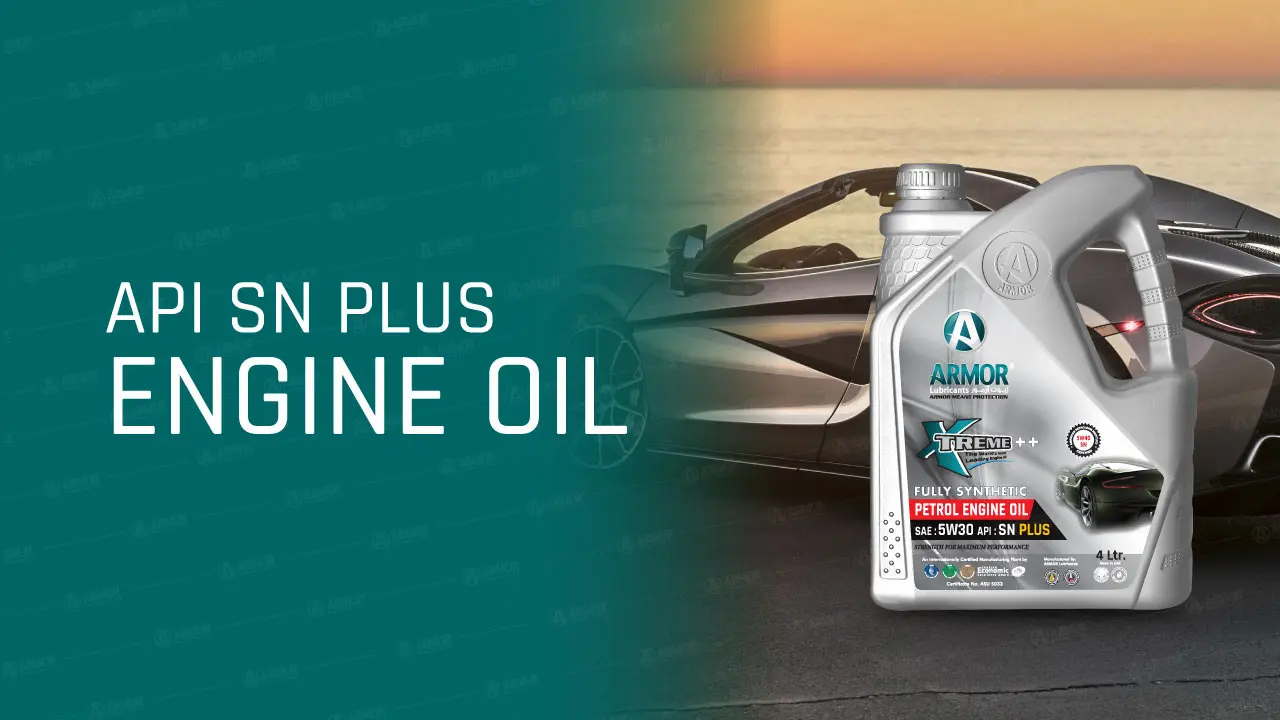
The American Petroleum Institute created API SN PLUS as a highly specific motor oil specification. This engine oil standard directly answers the growing performance requirements of modern vehicles. It provides crucial protection against sudden, catastrophic engine failures.
You will find this specific designation printed clearly on the lubricant label. It indicates the oil formulation passes rigorous tests for turbochargers and direct injection systems. This new standard ensures advanced engine protection far beyond previous limits.
Previously, the standard API SN categorization handled basic wear and high-temperature deposits. However, automotive engineers noticed new engine damage patterns emerging in modern vehicles. The industry urgently needed a robust chemical update to prevent rapid engine failure.
As a result, the standardization committee fast-tracked the new API SN PLUS designation. It bridges the critical performance gap before the formal release of API SP. This supplemental category specifically targets highly stressed, modern turbocharged power plants.
Blenders changed the chemical additive packages significantly to meet this new specification. They drastically reduced calcium-based detergents, which were linked to harmful premature ignition events. New chemical compounds replace them to keep the internal engine clean safely.
These updated detergents still prevent heavy sludge build-up and common oil leaks effectively. The revised formulation maintains strict internal cleanliness standards without triggering unwanted fuel ignition. For more details on these chemical bases, review our how engine oil works complete guide.
The new API SN Plus requirement really is needed to combat a specific, highly destructive mechanical phenomenon. Low-speed pre-ignition occurs when fuel ignites prematurely inside the hot combustion chamber. This happens during low speeds and heavy, sudden acceleration.
This abnormal ignition creates massive, uncontrollable pressure spikes inside the engine cylinder. These sudden force waves hit the piston violently as it travels upward. The resulting opposing forces severely stress internal components and lead to catastrophic engine failure.
LSPI stands for low-speed pre-ignition, which is a highly destructive form of engine knock. You will often hear a loud banging or metallic knocking noise. It happens when engines at low speeds try to accelerate rapidly under heavy loads.
Microscopic droplets of engine oil mix with fuel directly inside the cylinder. This volatile mixture sometimes ignites long before the spark plug actually fires. The resulting uncontrolled explosion damages pistons and turbochargers almost instantly.
Automotive engineers have studied the root cause of LSPI extensively to find viable fixes. It can be prevented using higher octane fuels, retarding ignition timing, or by using a lower compression ratio, among other solutions. The newest solution relies heavily on advanced lubricant chemistry.
Changing the actual oil formulation proved to be the most cost-effective and immediate industry fix. By altering the specific detergent chemistry, oil manufacturers eliminated the primary chemical trigger. This prevents these massive premature explosions completely.
This motor oil specification requires all approved lubricants to pass a specific engine test for pre-ignition. Formulators use different detergent combinations, often replacing problematic calcium with safer magnesium. Magnesium prevents the fuel-oil droplets from igniting early under high pressure.
How can motor oil help to prevent LSPI effectively during daily driving? It works by controlling the chemical reactivity inside the hot combustion chamber. The right engine oil prevents the microscopic oil droplets from acting as an unintended spark plug.
Modern automakers utilize much smaller engines equipped with advanced turbos to maximize fuel efficiency. These specialized setups force compressed air into the engine to generate much higher power output. This creates immense heat and extreme pressure inside the block.
Turbochargers operate at incredibly high rotational speeds and face extreme exhaust temperatures. They require a highly specialized lubricant to cool delicate bearings and prevent oil coking. Standard older oils break down quickly in this brutal operating environment.
Gasoline direct injection systems spray highly pressurized fuel directly into the combustion chamber. While fantastic for fuel economy, this method washes protective oil off the cylinder walls. It mixes raw fuel directly with the critical protective oil film.
TGDI engines combine advanced turbos with direct-injection technology for maximum power. This combination creates the exact volatile environment where low-speed pre-ignition thrives. The high cylinder pressure and fuel-oil mixing create the perfect conditions for severe engine damage.
API SN PLUS oil forms a highly durable chemical barrier inside the block. It easily withstands the extreme operating conditions of turbocharged gasoline direct injection engines. It prevents the oil from breaking down under the intense heat generated by modern turbos.
Protecting internal pistons from pre-ignition forces saves drivers thousands in potential mechanical repairs. The advanced formulation guarantees that the high-speed moving parts remain perfectly lubricated and intact. For comprehensive advice on selecting products, read choosing right vehicle engine oil.
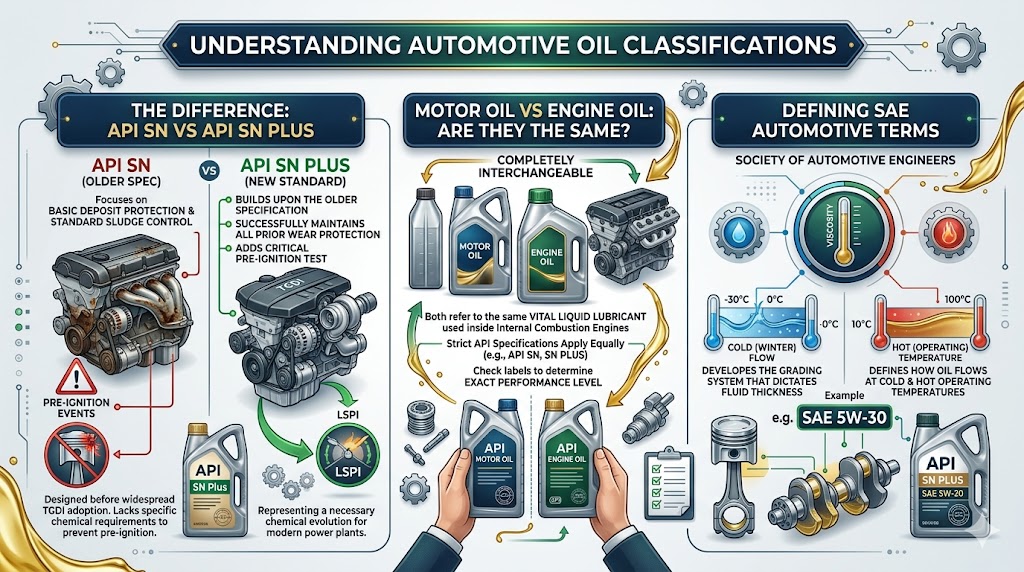
The older API SN focuses primarily on basic deposit protection and standard sludge control. It was designed years before the widespread global adoption of TGDI technology. It simply does not contain the specific chemical requirements to prevent pre-ignition events.
SN PLUS is a new standard that builds directly upon the older, established specification. It successfully maintains all the prior wear protection benefits but adds the critical pre-ignition test. It represents a necessary chemical evolution for modern power plants.
Many drivers frequently wonder, is motor oil the exact same as engine oil? Yes, these terms are completely interchangeable throughout the entire automotive industry. Both terms refer to the vital liquid lubricant used inside internal combustion engines.
Whether you prefer to call it motor oil or engine oil, the strict API specifications apply equally. Reading the labels helps you determine the exact performance level of the product inside the bottle. It guarantees you buy the right engine oil.
Many consumers ask, but what does SAE stand for on the bottle? The Society of Automotive Engineers develops the grading system that dictates fluid thickness. This regulatory body defines exactly how oil flows at both cold and hot operating temperatures.
So, what is SAE oil fundamentally? It is simply a commercial lubricant graded by this standardized automotive system. When evaluating any API SN PLUS product, you will always see an accompanying SAE viscosity grade printed clearly.
API SP is the absolute newest standard and easily surpasses both older automotive specifications. It offers enhanced protection against timing chain wear and even stricter LSPI controls. If comparing API SP vs SN, the SP category is vastly superior in every metric.
Can I use API SP instead of API SN or SN PLUS? Absolutely. Newer API service categories are entirely backward compatible by strict design. They provide exceptional, upgraded protection for older engines that specify earlier fluid standards.
Major lubricant brands formulate their top-tier full synthetic products to meet the rigorous API SP standard. These advanced lubricants excel in fuel efficiency, total sludge control, and overall extended engine longevity. They represent the current absolute pinnacle of automotive lubrication technology.
When reviewing any API SP oil list, you will almost exclusively find full synthetic formulations. The required base oil quality needed to pass these tests is extremely high. Conventional oils generally struggle to meet these highly advanced testing criteria.
A highly common question is whether the new API SN PLUS standard is backward compatible. Yes, it safely and effectively lubricates older engines originally designed for earlier specifications. It provides vastly superior deposit control without harming older internal seals.
Using an advanced chemical formulation in an older vehicle often significantly improves internal cleanliness. The highly updated additive packages actively scrub away old, baked-on sludge. This keeps the high-mileage engine running efficiently for a much longer period. Check out our api sn plus oils section.
Selecting the exact right viscosity is absolutely critical for maximizing engine protection. Are all 5W-30 motor oils equal in performance? No, they are certainly not. A standard 5W-30 SN oil completely lacks the vital pre-ignition protection found in a 5W-30 SN PLUS product.
You must carefully check both the numeric viscosity and the API rating shield. Using a lighter weight like 0W-20 often greatly improves daily fuel economy. However, it must still carry the correct API approval to prevent catastrophic internal damage.
The SAE designation only defines the thickness of the fluid, not its base composition. An SAE oil can be conventional, a synthetic blend, or a full synthetic product. Synthetic oil refers strictly to how the complex base lubricant is chemically manufactured.
Can I switch from conventional motor oil to synthetic without issues? Yes, you can easily and safely switch at your next service. Modern synthetics offer vastly superior protection and remain fully compatible with any conventional residues left in the internal engine.
If your vehicle owner’s manual specifically asks for API SM or API SN, you can safely upgrade. Using SN PLUS simply provides a much wider margin of safety against extreme wear. It guarantees your older engine operates under highly optimal conditions.
This backward compatible standard helps simplify overall commercial fleet maintenance. Fleet operators can easily stock a single advanced motor oil specification. This totally prevents accidental misapplication while servicing a highly diverse range of vehicle ages and types. Read our api sn plus oil ultimate guide.
The International Lubricant Standardization and Approval Committee also sets crucial, rigorous industry benchmarks. The ILSAC standard focuses heavily on improving overall fuel economy and lowering vehicle emissions. Their latest GF-6 specification works directly alongside strict API SP requirements.
Both API and ILSAC collaborate closely to ensure modern vehicles run cleanly and highly efficiently. These joint standards dictate how lubricants must perform across all global automotive markets. They constantly push formulators to develop vastly better, safer chemical compounds.
ILSAC GF-6A specifically targets widely used consumer viscosity grades like 5W-30 and 0W-20. It demands extremely rigorous testing for timing chain wear and strict pre-ignition control. Oils passing this standard maximize your vehicle's fuel economy continuously during operation.
These highly advanced lubricants reduce internal mechanical friction significantly across all moving parts. By allowing metal parts to slide easily, the engine uses far less fuel to generate power. This incredible efficiency translates directly into noticeable savings at the gas pump.
The standardization and approval committee evaluates emerging engine technologies constantly. They monitor how new direct fuel injection systems impact overall lubricant degradation. Their rigorous research dictates exactly when a new motor oil specification must be developed and released.
By standardizing these performance requirements, they protect global consumers from catastrophic engine failure. They ensure every bottle of certified lubricant meets a strict, verifiable performance baseline. This global standardization is vital for maintaining long-term automotive reliability.
No matter how highly advanced the oil specification is, routine preventive maintenance remains vital. Following the manufacturer’s suggested oil drain interval prevents severe, damaging sludge build-up. Regular changes flush out harmful chemical contaminants and combustion byproducts effectively.
Waiting far too long between scheduled changes completely depletes the crucial additive packages. Once the specialized detergents wear out, the engine becomes highly vulnerable to low-speed pre-ignition again. Fresh oil guarantees maximum, continuous protection for turbochargers and delicate bearings.
You must always consult your vehicle owner’s manual before purchasing any automotive lubricant. The manufacturer specifically outlines the exact viscosity and API category required for optimal performance. Ignoring these engineering guidelines can easily void your costly powertrain warranty quickly.
If the printed manual specifies API SN PLUS, you must never downgrade to standard API SN. Your complex TGDI engine relies completely on those specific chemical protections to survive. Proper initial fluid selection is the absolute foundation of long-term automotive reliability.
Strict, regular preventive maintenance keeps the critical combustion chamber free of heavy carbon deposits. Carbon actively acts as a sponge for unburned fuel, which rapidly triggers pre-ignition events. Clean cylinders always promote incredibly smooth, highly predictable power delivery.
By consistently using the correct, high-quality engine oil, you ensure your vehicle performs precisely as engineered. Investing in the absolute right specification today prevents highly catastrophic failures tomorrow. Check out know about your car engine oil for further advanced insights.