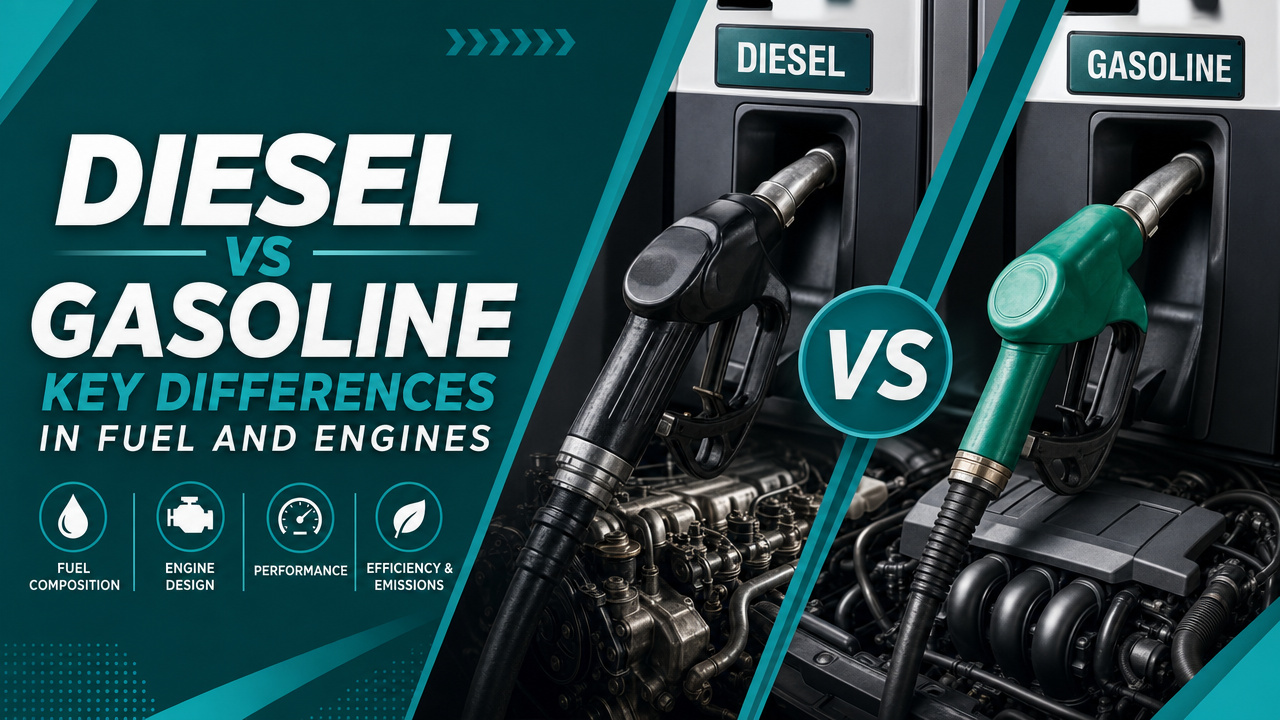
Diesel and gasoline power two distinct engine architectures, each with unique combustion principles, lubrication demands, and operational economics. For fleet managers, mechanics, and engine builders, knowing the precise differences between diesel and gas engines drives smarter decisions on fuel, oil selection, and maintenance scheduling.
This guide breaks down the technical contrasts between diesel vs gasoline engines, covering combustion, energy density, engine oil chemistry, and total cost of ownership. Whether you operate commercial vehicles or passenger cars, the right insight ensures optimal engine protection and fuel economy.
Diesel fuel is a heavier, oilier hydrocarbon distilled at higher temperatures than gasoline. It contains longer carbon chains (C10 to C15), giving it greater density and a higher flash point. Gasoline, by contrast, is lighter and more volatile, evaporating quickly at ambient temperatures.
The chemical structure directly influences combustion behavior. Diesel fuel energy density sits around 36 to 40 MJ per liter, while gasoline ranges between 32 and 34 MJ per liter. That gap explains why diesel engines deliver superior mileage in heavy duty commercial transport.
Gasoline vs diesel fuel also differs in cetane and octane ratings. Diesel relies on cetane numbers for ignition quality, while gasoline depends on octane to resist premature detonation in spark ignition engines.
The core mechanical difference between diesel and gas engines lies in ignition. A compression ignition engine compresses air to extreme pressures, raising temperatures high enough to auto-ignite injected diesel. No spark plug is required—glow plugs only assist cold starts.
A spark ignition engine mixes gasoline and air, then uses spark plugs to trigger combustion. This allows gasoline engines to operate at higher rpm but at lower compression ratios, typically 8:1 to 12:1, versus 14:1 to 25:1 for diesel.
Key operational contrasts include:
Diesel fuel's energy density gives it a measurable advantage. A diesel engine typically delivers 20 to 35 percent better fuel economy than a comparable gasoline engine. That diesel fuel economy advantage compounds across long-haul fleets and agricultural equipment.
Gasoline vs diesel fuel economy depends on duty cycle. For short urban trips, gasoline engines often perform adequately. For heavy loads, sustained highway speeds, or industrial power generation diesel applications, diesel dominates on operating cost per mile.
Diesel vs gasoline performance also shows in thermal efficiency. Diesel engines convert roughly 40 to 45 percent of fuel energy into mechanical work, while gasoline engines hover around 25 to 30 percent.
Diesel engine oil vs gas engine oil is not interchangeable without consequences. Diesel oil contains higher detergent and dispersant levels to handle diesel soot management, acid neutralization, and sludge build up under high-load conditions.
Gasoline engine oil specifications prioritize friction reduction, fuel economy oil performance, and catalytic converter compatibility. Passenger car motor oil (PCMO) carries lower additive concentrations to protect emission systems, while heavy duty motor oil (HDMO) carries a higher total base number (TBN) for acid control.
Common viscosity grades reflect these differences:
API CK-4 vs API SP illustrates the regulatory split. API CK-4 heavy duty engine oil targets modern diesel engines with EGR and DPF systems. API SP motor oil meets the latest gasoline engine demands, including LSPI protection.
Can you use diesel oil in a gas engine? Technically yes for short periods, but the higher ash content can damage catalytic converters and shorten emission system life. The difference between API SN and API CK-4 makes them better suited to their respective applications.
Maintenance cost diesel vs gas favors gasoline engines on routine service but diesel engines on longevity. Diesel engines run cleaner internally with proper lubrication and often exceed 500,000 miles in commercial service.
Diesel maintenance costs include:
Gasoline maintenance costs include:
For fleet management total cost of ownership, diesel typically wins in high-mileage applications. For low-mileage passenger use, gasoline offers a lower entry and service cost.
Choosing between diesel and gasoline comes down to load, mileage, and duty cycle. Diesel fleet applications—long-haul trucking, agricultural equipment lubrication, construction, and industrial power generation—benefit from torque, efficiency, and engine longevity.
Gasoline fits passenger cars, light commercial use, and high-rpm performance vehicles. For towing capacity, sustained heavy loads, or commercial fleet oil planning, diesel remains the practical choice.
When selecting the right lubricant for diesel or gasoline engines, consider these factors:
Mineral oil vs full synthetic also factors in. Full synthetic passenger car motor oil delivers superior wear protection and friction reduction in modern gasoline engines. Semi synthetic heavy duty oil balances cost and performance for mixed diesel fleets.
Armor Lubricants engineers high performance diesel engine oil and premium motor oil for both fuel types. From SAE 15W40 HDMO with API CK-4 certification to SAE 5W30 full synthetic PCMO meeting API SP, the right product ensures equipment protection, oxidation stability, and long drain interval performance.
For recommended oil for diesel trucks, best engine oil for gas cars, or guidance on lubricating heavy duty diesel engines, refer to the Armor Lubricants diesel vs gas oil guide. Matching the correct viscosity grade, API specifications, and anti wear additives to your engine architecture protects against wear and tear, controls diesel engine deposits, and maximizes return on every liter.