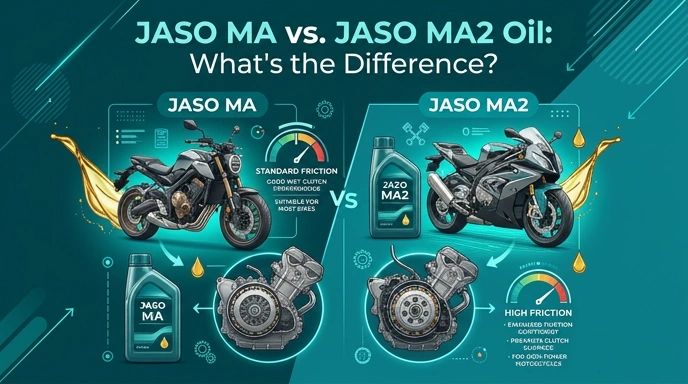
The distinction between JASO MA and JASO MA2 specifications dictates the performance of a shared sump motorcycle engine. These standards, established by the Japanese Automotive Standards Organization, define how lubricants interact with a wet clutch system. The primary difference lies in the coefficients of friction delivered by the oil.
JASO MA serves as the broad standard for four-stroke motorcycles with a single oil system for the engine, gearbox, and clutch. It encompasses oils that provide sufficient friction to prevent clutch slippage in general riding conditions. This specification effectively bridges the gap between automotive oils and motorcycle-specific fluids.
JASO MA2 eliminates the lower friction ranges found in the broader MA category. This specific subset enforces higher friction indices, ensuring distinct grip capability. Modern motorcycles with high torque outputs require this increased friction to transfer power efficiently to the rear wheel without energy loss through slippage.
The JASO T903 standard categorizes oils based on three specific friction indices. These valid measurements determine if a lubricant falls under the umbrella MA classification or the narrower MA2 tier. Understanding these indices clarifies why one oil performs differently than another in high-stress scenarios.
The indices measured are the Dynamic Friction Index, the Static Friction Index, and the Stop Time Index. Each metric evaluates a distinct phase of clutch engagement and disengagement. The MA standard permits a wider range of values across these three metrics compared to the MA2 specification.
The Dynamic Friction Index (DFI) measures how the clutch feels during engagement while the plates are spinning. A higher DFI ensures a strong, progressive bite as the rider releases the clutch lever. JASO MA2 oil requires a DFI range of 1.50 to 2.50.
In contrast, the broader MA classification formerly allowed lower values. By strictly enforcing the higher range, MA2 oils prevent the vague sensation of slippage during aggressive acceleration. This creates a direct correlation between engine RPM rise and vehicle speed.
Static Friction Index (SFI) dictates reliability when the clutch is fully engaged preventing slip under high load. This measures the resistance to slippage once the clutch plates are locked together. High torque engines demand high static friction to maintain lockup.
JASO MA2 mandates an SFI of 1.60 to 2.50. This high threshold is critical for heavy cruisers and sportbikes. If the oil falls below this range, the clutch may slip imperceptibly at peak torque, causing heat buildup and premature plate wear.
The Stop Time Index (STI) assesses how quickly the clutch brings the system to synchronization. This metric influences the speed of gear changes and the crispness of the transmission. A low STI can result in sluggish shifts or clutch drag.
MA2 compliant lubricants must meet an STI range of 1.55 to 2.50. This ensures rapid engagement necessary for quick shifters and performance riding. Oils that fail to meet this specific velocity of engagement often result in a clunky transmission feel.
The JASO T903 standard was introduced to solve the incompatibility of modern automotive oils with motorcycle engines. Automotive lubricants evolved to include friction modifiers to improve fuel economy. These modifiers are disastrous for wet clutches, causing immediate slippage.
JASO MA was the initial answer, establishing a baseline for non-friction modified oils. However, as fluid technology advanced, the single MA standard proved too broad. It included oils with friction characteristics that were barely adequate for high-performance machines alongside oils that were exceptional.
In 2006, the standards body split the MA category into MA1 and MA2. MA1 represented the lower friction side of the spectrum, while MA2 represented the higher friction side. Today, JASO MA2 is the dominant recommendation for modern liquid-cooled, four-stroke motorcycles.
Verification of these standards involves the SAE No. 2 Friction Test methodology. Technicians simulate thousands of engagement cycles to measure torque transfer stability. The oil must maintain its indices within the specific parameters throughout the test duration.
The test also strictly monitors consistency. An oil cannot start with MA2 properties and degrade into MA1 territory after thermal stress. This ensures the rider experiences consistent clutch feel from the beginning to the end of the oil change interval.
Beyond friction, the standard dictates rigid chemical limits. These include sulfated ash content, phosphorus levels, and evaporative loss. These chemical constraints ensure the oil protects the engine internals while maintaining clutch performance.
Sulfated ash is capped to prevent deposits on piston crowns and valves. Phosphorus is limited to protect catalytic converters in the exhaust system. Meeting these chemical properties is a prerequisite before friction testing even begins.
Engine architectures have shifted toward higher power density. Engineers now extract over 200 horsepower from light liter-class engines. This immense power passes through compact clutch baskets that have not grown proportionally in size.
To compensate for surface area limitations, the clamping force and friction coefficient must increase. JASO MA2 motorcycle oil provides the necessary chemical friction assist. Without this standard, the mechanical grip of the plates alone would be insufficient.
Modern emission standards like Euro 5 enforce strict limits on exhaust pollutants. Manufacturers utilize sensitive catalytic converters to scrub exhaust gases. Phosphorus and sulfur, common anti-wear additives, can poison these catalysts over time.
JASO MA2 formulations often align with higher API grades that limit phosphorus volatility. This synergy protects the exhaust filtration system. Using an older spec oil could lead to premature catalyst failure and failed emissions tests.
Effectively managing heat in a shared sump is a massive challenge. The oil directly contacts the combustion chamber, lubricates the transmission gears, and cools the clutch pack. Each area subjects the fluid to different forms of stress.
Shear stability is paramount in this environment. The meshing of transmission gears acts like a pair of scissors on the oil molecules. JASO MA2 oils are formulated to resist this permanent viscosity loss, ensuring the protective film remains thick even at high temperatures.
Riders often ask if they can use MA2 oil in an older bike specifying MA. The answer is generally yes. JASO MA2 is a higher performance subset of the original MA specification. It provides superior grip assurance.
However, using a lower spec oil in a modern machine is risky. If a manual calls for JASO MA2, utilizing a generic MA oil may result in clutch slip. The lower end of the MA friction scale provides insufficient grip for mapped high-output engines.
Downgrading from MA2 to a generic MA fluid can degrade ride quality. The clutch may feel spongy or inconsistent. Under hard acceleration, the RPMs may flare without a corresponding increase in speed.
This slippage creates excessive heat within the clutch pack. This heat degrades the oil rapidly, leading to oxidation and sludge formation. Eventually, the friction plates will glaze, requiring expensive mechanical replacement.
Putting JASO MA2 into a vintage motorcycle is usually safe and beneficial. The higher friction characteristics ensure solid lockup on worn clutch springs. It can revitalize the shift feel of an aging transmission.
One exception involves extremely old separate-gearbox British or American motorcycles. These may not require JASO standards at all. However, for any Japanese metric cruiser or sportbike from the 1980s onward, MA2 is a superior choice.
The acronym soup on oil bottles can be confusing. It is vital to distinguish the MA series from other JASO specifications. JASO FD, for example, is for two-stroke engines. Putting FD oil in a four-stroke sump will cause catastrophic failure.
Similarly, JASO DH 2 refers to heavy-duty diesel engine oil. While diesel oils are robust, they lack the specific friction balancing for motorcycle wet clutches. Some riders experiment with Rotella (a diesel oil), but verified MA2 oils remove the guesswork.
JASO MB is the polar opposite of MA and MA2. It denotes oil designed for low friction applications. This standard is typically found in scooters with dry CVT transmissions where engine oil does not touch the drive belt.
Pouring JASO MB oil into a wet-clutch motorcycle will drastically reduce friction. The clutch will slip immediately. Always verify the label specifically says MA or MA2, never MB, for distinct manual transmission motorcycles.
JASO ratings work in tandem with API (American Petroleum Institute) grades. You will often see a bottle labeled "API SN / JASO MA2". The API grade defines the engine protection quality, while the JASO grade defines the clutch suitability.
Older specs like API SJ JASO MA differ from modern API SN JASO MA2 in additive packages. The newer SN grade offers better deposit control, while the MA2 component ensures the friction modifiers introduced in SN do not ruin the clutch.
Authentic JASO MA2 products display a rectangular seal on the bottle. This seal contains the categorization code (MA or MA2) in the top half. The bottom half displays a unique registration number assigned by the JASO organization.
Major brands usually display numbers starting with M followed by a code. This signifies strict adherence to the testing protocols. Beware of boutique oils that claim to "meet requirements" without displaying the official square seal.
The JASO standard is independent of viscosity. You can buy JASO MA2 10W40, 20W50, or 5W40. The viscosity denotes the flow characteristics, while the JASO rating denotes the friction characteristics.
Riders must select the viscosity based on ambient temperature and manufacturer clearance tolerances. A JASO MA2 10W40 is the most common all-rounder for liquid-cooled sportbikes. Air-cooled V-twins often prefer the thicker film of a 20W50 MA2.
JASO MA2 certification applies to mineral, semi-synthetic, and full synthetic oils. The friction indices are achievable with any base stock. However, synthetic oils generally maintain those indices longer under heat stress.
A mineral JASO MA2 oil provides the correct grip when new. However, it may shear out of grade faster than a synthetic counterpart. For extended drain intervals, a synthetic MA2 fluid offers the best longevity.
Large V-twin engines generate massive torque at low RPMs. This places immediate, heavy load on the clutch springs and plates. JASO MA2 oil is essential here to prevent the clutch from breaking loose during low-speed chatter.
Inline-four engines generate power at high RPMs. They subject the oil to extreme shear forces in the gearbox. The robust additive packages in MA2 oils protect the gears from pitting while ensuring the clutch holds firm at the redline.
JASO standards place caps on sulfated ash. This is relevant for engine cleanliness. High ash content can lead to pre-ignition or detonation in high-compression engines if deposits form on the piston.
Controlling ash while maintaining high Total Base Number (TBN) for acid neutralization is a balancing act. MA2 oils optimize this balance. They keep the engine clean without compromising the friction required for the drivetrain.
The life of a wet clutch depends heavily on the oil quality. Contaminated oil embeds particulates into the friction material. Oil that has lost its friction properties causes micro-slippage that glazes the plates.
Regular changes with JASO MA2 fluid flush out the abrasive clutch dust. This suspension of contaminants is a key function of the oil. Fresh fluid restores the indices to the optimal range, preserving the hardware.
Choosing between MA and MA2 simplifies down to vehicle age and performance level. For almost any motorcycle manufactured after 2006, MA2 is the safe, default choice. It covers all requirements of the previous MA standard with added precision.
For older, low-power commuter bikes, a basic JASO MA oil is sufficient. However, given the market shift, finding pure "MA" (without the MA2 identifier) is becoming rarer. The industry has largely standardized on the higher performance specification.
The owner's manual remains the ultimate authority. Manufacturers perform durability testing with specific oil grades. If the manual lists JASO T903 MA2 as a requirement, deviating to an automotive oil is a gamble with expensive consequences.
Some manuals may still list API SG or SH. These are obsolete API standards. In these cases, a modern API SL or SM oil that is also JASO MA2 certified is the correct modern equivalent. It provides better protection than the original spec.
Always verify the absence of "Energy Conserving" wording on the API donut symbol if the JASO seal is missing. While JASO MA2 guarantees clutch safety, the presence of energy-conserving labels guarantees clutch slippage. The JASO seal is the shortcut to safety.
The distinction between JASO MA and MA2 is a matter of precision. MA2 is the refined, high-performance evolution of the broader MA class. By adhering to the stricter friction limits, it ensures that modern, high-output motorcycles deliver their power to the road reliably and consistently.