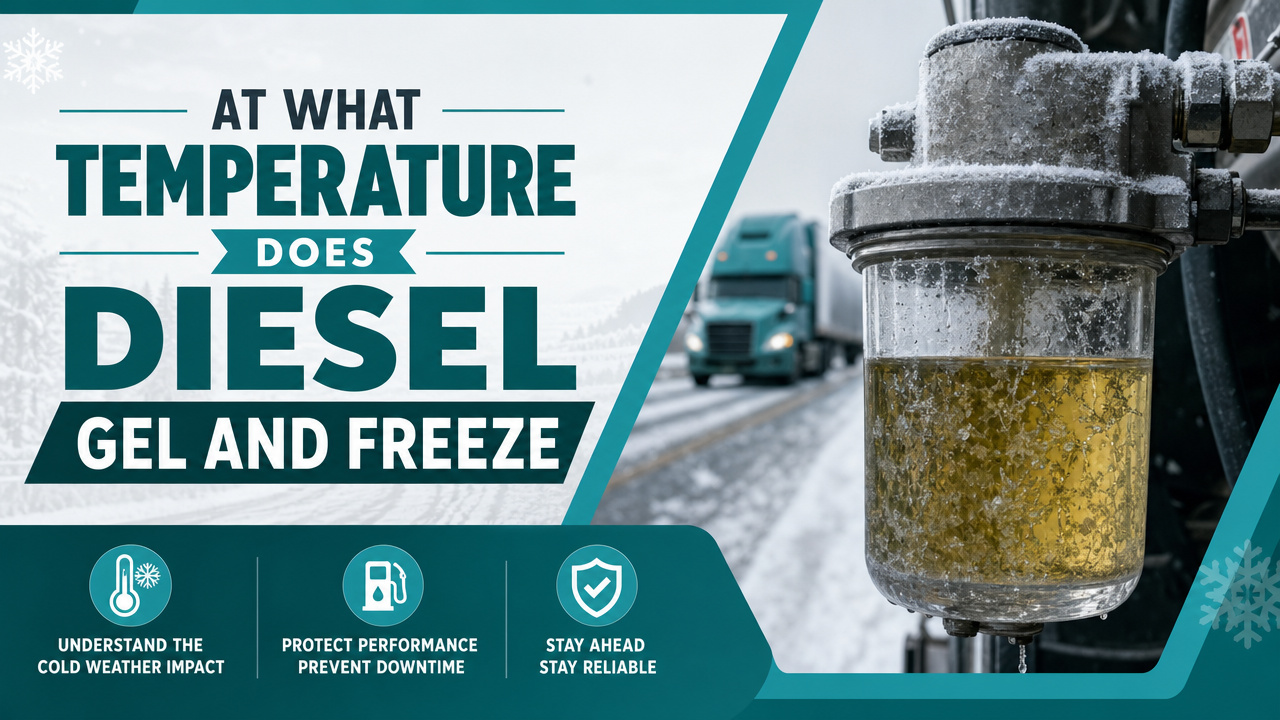
Cold weather hits diesel hard. As temperatures drop, paraffin wax crystals form inside the fuel, restricting flow and choking filters. For fleet operators, equipment managers, and heavy-duty diesel owners, knowing the exact thresholds where diesel gels and freezes is critical to avoiding downtime and engine damage.
This guide breaks down the science, the temperature points, and the additive strategies that keep diesel flowing when winter sets in.
Three temperature markers define diesel cold flow characteristics. Each signals a different stage of wax formation and viscosity breakdown.
The diesel cloud point vs pour point comparison matters because filters plug long before the fuel fully solidifies. CFPP usually falls between cloud point and pour point, making it the most operationally relevant figure.
So when does diesel gel? Standard #2 diesel begins gelling at around 32°F (0°C), with full gelling typically occurring between 10°F and 15°F (-12°C to -9°C). The diesel gelling temperature varies by blend, additive package, and regional formulation.
At the diesel fuel gel point, paraffin wax crystals bond together and form a thick, waxy mass. Fuel flow restrictions begin immediately, fuel injector protection drops, and cold start protection collapses without proper additives.
Common symptoms of gelled diesel fuel include hard starts, loss of power, stalling, and complete fuel filter plugging. If you suspect gelling, do not crank the engine repeatedly — you risk lubrication starvation and pump damage.
Diesel does not freeze in the traditional sense like water. Instead, it transitions from cloudy to gelled to semi-solid. The diesel fuel freezing point for #2 diesel is approximately -112°F (-80°C), well below any operational climate.
However, the practical diesel freezing temperature — the point where the fuel will not flow or pump — is the pour point, typically around -10°F to -20°F (-23°C to -29°C) for untreated #2 diesel.
For #1 diesel, the freezing and gelling thresholds drop significantly. The temperature diesel freezes at depends heavily on grade, additives, and whether the fuel is winterized.
The number 1 vs number 2 diesel debate comes down to chemistry and cold-weather behavior.
Many regions blend the two during winter months — known as winter blend vs 2 diesel — to balance cold flow with fuel economy. Why use number 1 diesel in winter? Because it dramatically lowers the gel and pour points without the need for heavy additive dosing.
Diesel cold flow improvers and diesel fuel anti gel products modify wax crystal behavior. They don't remove paraffin — they change how the wax forms and behaves.
Here's how a premium anti gel works:
For commercial fleet lubricants and heavy duty diesel fuel treatment, OEM approved diesel fuel additives are non-negotiable. Choosing the right anti gel for diesel depends on your climate, fuel grade, and storage setup.
How to ungel diesel fuel fast requires patience and the right approach. Can you run gelled diesel fuel? No — running gelled diesel risks pump failure, injector damage, and lubrication starvation.
Follow these steps for treating already gelled diesel fuel:
Once thawed, top off with winterized diesel fuel and a quality cold weather additive before restarting.
Preventing diesel gelling in trucks and heavy equipment starts before the cold snap. Smart winter prep saves repair costs and operational hours.
For fleet cold weather maintenance, build a winterization checklist covering fuel storage tank winter maintenance, lubricant grade selection for extreme cold, and preventative maintenance schedules. Off-highway equipment winterization and generator cold weather operation require the same discipline — power generation fuel storage especially benefits from oxidation stability treatments in long-term cold storage.
Whether you're managing a commercial truck, marine diesel application, or industrial diesel generator, the formula stays the same — match the right fuel, the right additive, and the right oil to your operating temperature. That's how you prevent engine damage and keep diesel running through the coldest months.
Armor Lubricants offers fully synthetic heavy duty engine oil, semi synthetic diesel oil, and premium winterized fuel formulas engineered for winter climate operations. Choose the right winter diesel treatment and protect your equipment before the temperature drops.