Getting the right blend of oil and gasoline is the single most important task for any two-stroke engine owner. Unlike four-stroke engines, two-cycle engines rely on premixed fuel for piston ring lubrication, crankshaft bearing protection, and anti-scuffing performance during combustion.
This guide walks you through exact ratios, measurements in gallons and liters, and the correct procedure to premix 2-stroke fuel. Whether you run a chainsaw, dirt bike, string trimmer, or marine outboard, precision matters for engine wear protection and fuel oxidation stability.
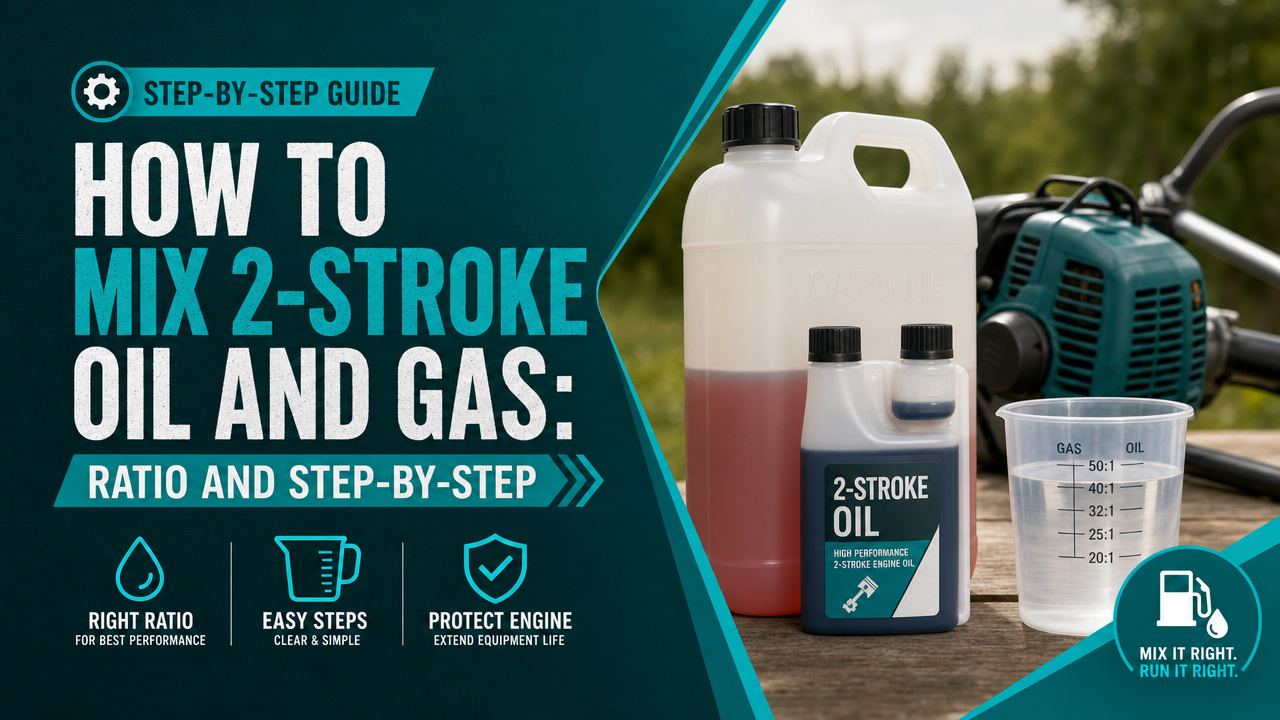
The 2-stroke oil mix ratio expresses parts of gasoline to one part oil. A 50:1 gas oil mix means 50 units of fuel to 1 unit of oil. Modern engines using synthetic 2t oil often run leaner ratios thanks to improved lubricity.
Always follow the manufacturer's recommended 2-stroke oil grade. Running the wrong 2 stroke mix ratio causes spark plug fouling, exhaust port deposits, or piston seizure.
Knowing how much 2 stroke oil per gallon of gas eliminates guesswork. The chart below converts ounces to gallons for 2 cycle premix using US measurements.
For a 2.5-gallon jerry can at 50:1, use 6.4 oz of oil. This is the standard string trimmer fuel mix and dirt bike premix volume most users prepare.
Calculating oil to gas ratio in ml is straightforward with metric measurements. Use these figures per liter of gasoline.
For a 5-liter can at 50:1, add 100 ml of oil. A measuring syringe for oil or a marked 2 stroke oil mixing cup gives the accuracy needed for a homogenous fuel blend.
Follow this sequence for premixing 2 cycle fuel safely and accurately. Never mix directly in the engine tank.
The best container for mixing gas is a certified, sealed jerry can with a vapor-tight cap. Metal or high-density polyethylene cans rated for gasoline prevent fuel oxidation and evaporation.
Essential tools include a measuring syringe for oil, a funnel with a fine mesh filter, and a dedicated 2 stroke oil mix calculator (mobile app or printed chart). Jerry can mixing works best when the can has a wide mouth for shaking.
How long does mixed 2 stroke gas last? Premixed fuel remains stable for approximately 30 days without additives. After that, gasoline begins to oxidize, forming varnish and combustion chamber deposits that clog carburetors.
Adding a 2 cycle engine fuel stabilizer extends storage to 3–6 months. This is critical when winterizing a 2 stroke engine or storing seasonal equipment like marine outboards, snow blowers, or power generation 2 cycle generators.
To revive old premixed gas, dispose of any fuel older than six months. Old mixtures lose octane, cause lean fuel mixture conditions, and risk piston damage. Always store premix in a cool, dark place with the cap tight.
The two most damaging errors are using the wrong 2 stroke mix ratio and the wrong 2 stroke oil type. Both lead to symptoms of incorrect 2 stroke mix including smoke, hard starting, and loss of power.
What happens if you put too much 2 stroke oil in gas? The engine runs rich, fouling the spark plug, producing heavy exhaust smoke, and coating the exhaust port with carbon. Too little oil causes catastrophic scoring and piston seizure.
Can you use any 2 stroke oil for premix? No. Oil must match the engine type and application specification.
Conventional mineral 2-stroke oil suits older, low-RPM engines and budget applications. Semi synthetic 2 cycle oil offers a balance of price and performance. Full synthetic 2t oil delivers superior anti-wear additives, low smoke output, and clean burning two stroke lubricant technology for high-performance engines.
These are the primary two-cycle engine protection standards.
Never use TC-W3 rating oils in air-cooled equipment or land-based JASO FD oils in outboards. Compatibility matters for optimum thermal stability and ashless dispersion additives designed for each environment.
Choosing the right oil, measuring 2t oil accurately, and storing premix properly protects your investment. A quality high performance 2-cycle lubricant from Armor Lubricants delivers engine wear protection, fuel economy, and emission reduction across chainsaws, dirt bikes, outboards, and heavy-duty agriculture 2 stroke equipment.