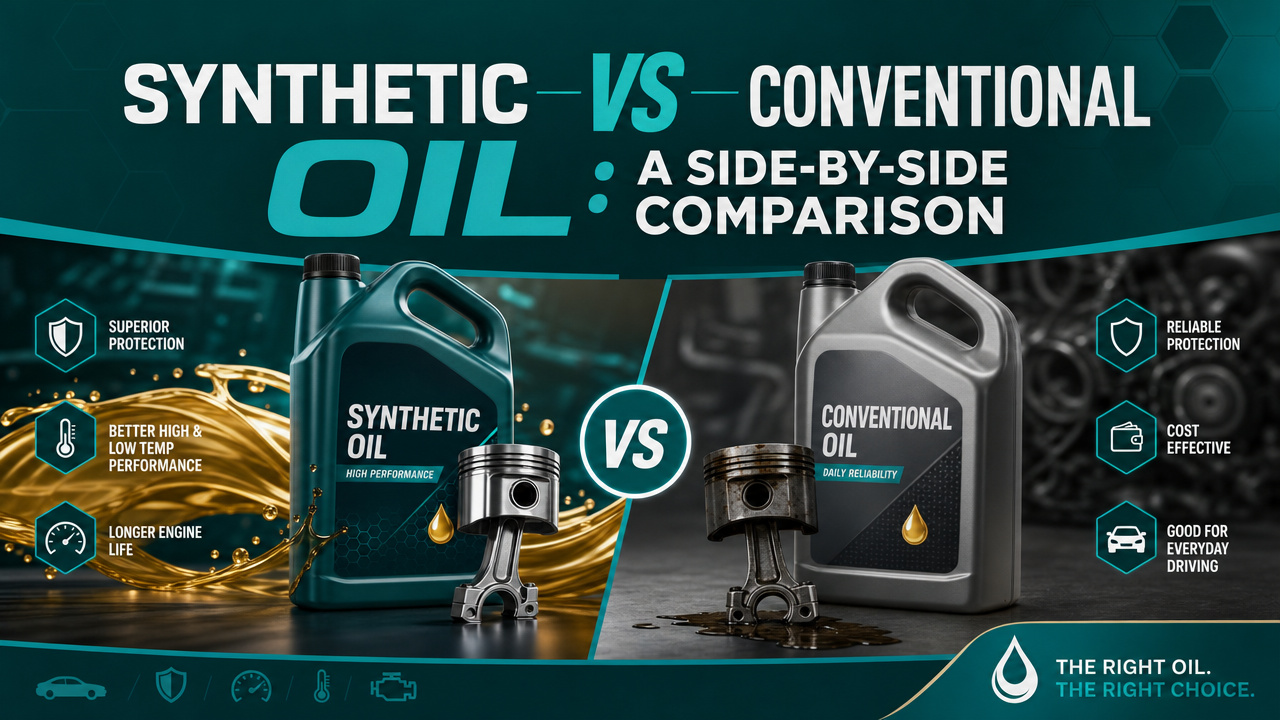
Choosing between synthetic and conventional oil directly impacts engine performance, maintenance costs, and equipment lifespan. This side-by-side breakdown compares base oil chemistry, viscosity behavior, wear protection, drain intervals, and cost so you can match the right lubricant to your vehicle or fleet.
Both fluids meet API SP, ACEA, and dexos approved oil specifications when properly formulated, but their refining paths and additive packages produce measurably different results under real operating loads.
Conventional oil starts with crude oil refining. The mineral base stock is distilled, dewaxed, and hydrotreated to produce Group II base oils. Additives such as detergent additives, anti wear additives, and viscosity index improvers are then blended to meet a target viscosity grade.
Synthetic oil is produced through chemical synthesis. PAO synthetic (Group IV polyalphaolefin) and Group III synthetic base stocks are engineered molecule by molecule, delivering uniform structure, higher thermal stability, and superior oxidation resistance compared to mineral base stock.
The difference in synthetic and conventional oil begins at this manufacturing stage. Synthetic lubricant formulation removes impurities like sulfur and paraffin waxes that remain in conventional engine oil vs synthetic refining, which directly affects long-term performance.
Synthetic oil performance difference is most visible at temperature extremes. At cold weather start, synthetic flows at -40°C while conventional thickens, delaying engine lubrication to internal engine components during the most damaging start-up seconds.
At high temperatures, conventional oil suffers high temperature breakdown faster. Synthetic resists viscosity breakdown over time, maintaining film strength in turbocharged gasoline engines, heavy duty diesel engine oil applications, and equipment running in hot climates.
For synthetic lubricant for extreme temperatures, full synthetic is the only practical choice. Mineral oil limitations become critical above 120°C sump temperatures.
Wear protection comparison favors synthetic oil. Uniform molecular size reduces friction and wear reduction across cam lobes, bearings, and piston rings. Anti wear additives bond more efficiently with cleaner synthetic base stock.
Engine cleanliness is where the gap widens. Synthetic oil actively works at preventing engine sludge by suspending contaminants until the next drain. Conventional oil leaves more engine deposits as it ages, accelerating sludge buildup in stop-and-go driving.
Synthetic also delivers stronger anti rust engine protection and anti foam characteristics, both critical for marine and construction equipment oils exposed to moisture and aerated operating conditions.
Synthetic oil change interval typically runs 7,500 to 15,000 miles depending on OEM approval requirements. Some premium synthetic oil performance grades support extended drain intervals up to 20,000 miles in passenger car lubrication applications.
Conventional oil change interval is 3,000 to 5,000 miles. Conventional oil life expectancy is shorter because oxidation stability in high heat is lower, and additives deplete faster under thermal stress.
For commercial fleet oil change intervals, long drain interval synthetics reduce downtime and total maintenance hours significantly.
Synthetic vs conventional cost per mile favors synthetic when calculated correctly. A full synthetic change at $80 covering 10,000 miles costs $0.008 per mile. Conventional at $35 covering 4,000 miles costs $0.0087 per mile.
Add fuel economy benefits of 1 to 2 percent from synthetic's lower friction, plus reduced wear on internal engine components, and the cost benefit analysis of synthetic motor oil tilts further in its favor for most drivers.
Is synthetic oil worth the extra cost? Yes, especially for high-mileage engines, turbocharged units, towing applications, and any vehicle operated in temperature extremes.
Synthetic blend vs conventional offers a middle path. Semi synthetic vs conventional uses 20 to 30 percent synthetic base stock mixed with Group II mineral oil, improving thermal stability without full synthetic pricing.
Synthetic blend vs full synthetic makes sense for light-duty passenger vehicles with moderate driving conditions. Semi synthetic benefits include better cold flow than conventional and longer drain intervals than mineral oil alone.
Use synthetic blend when:
Can you mix synthetic and conventional oil? Yes, they are chemically compatible, but you lose the performance edge of pure synthetic. Lubricant compatibility is not the issue; performance dilution is.
To choose the right oil for your car, start with the owner's manual recommended oil grade. Match SAE viscosity comparison, API SP standard (or API SP vs API SN for newer engines), and ACEA C3 engine protection ratings where specified.
For best oil for high mileage engines above 75,000 miles, full synthetic with seal conditioners prolongs engine life with synthetic chemistry that restores elastomer flexibility and reduces oil consumption.
Match the oil to the application:
For heavy duty fleet maintenance, high performance engine oil delivers maximum engine protection and the lowest total cost of ownership through extended drain intervals synthetic chemistry enables.
Finding the right lubricant comes down to matching base oil chemistry, viscosity grade, and additive package to operating conditions. Armor Lubricants product selection covers passenger car motor oil, heavy duty diesel engine oil, and industrial grades engineered to OEM approval requirements across automotive lubricants manufacturing standards.
The difference between regular motor oil and synthetic is clear in the data. For maximum engine protection, longer service intervals, and fully synthetic advantages across temperature extremes, synthetic remains the engineered choice. Conventional still has a place in older engines, short-trip vehicles, and budget-driven maintenance schedules where shorter drain intervals are acceptable.