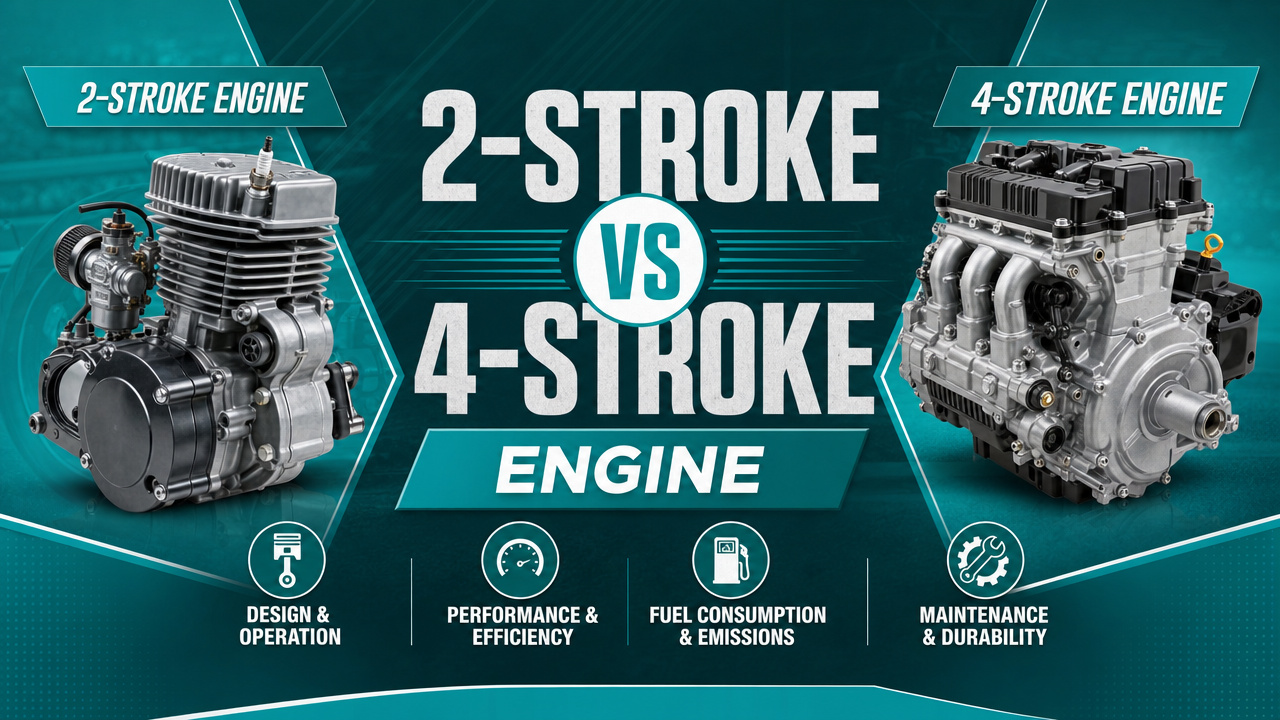
Engine architecture defines performance, efficiency, and lubrication demands. The 2 stroke vs 4 stroke engine debate matters because each design serves distinct applications, from dirt bikes to outboards to passenger vehicles. Selecting the right platform and matching oil is critical for engine protection.
This 2 stroke vs 4 stroke comparison breaks down engine cycle mechanics, power-to-weight ratio, fuel and oil requirements, emissions, and service life. Whether you run 2t motorcycle oil or 4t motorcycle oil, the difference between 2 stroke and 4 stroke shapes every maintenance decision.
A 2 cycle vs 4 cycle engine differs fundamentally in combustion sequence. The 2-stroke completes intake, compression, power, and exhaust in one crankshaft revolution. The 4-stroke separates each phase across two revolutions, delivering more controlled clean combustion.
In two cycle vs four cycle designs, the 2T uses transfer ports and a sealed crankcase for fuel-air delivery. The 4T uses dedicated intake and exhaust valves, camshafts, and an oil sump for independent crankcase lubrication.
This architectural gap explains why 2t vs 4t oil formulations differ. A 2-stroke burns oil with fuel, while a 4-stroke recirculates lubricant through a separate lubrication system, preserving additive integrity longer.
The power and torque difference between these platforms is significant. A 2T engine fires every revolution, producing higher power-to-weight ratio and aggressive high rpm performance. This makes 2 cycle engines dominant in chainsaws, trimmers, and racing karts.
A 4T engine fires every other revolution but delivers maximum torque at low rpm with smoother output. The heavier valvetrain and crankshaft assembly add mass but improve balance, durability, and fuel economy across variable loads.
Key trade-offs in the 4 stroke vs 2 stroke engine choice include:
The fuel and oil mixture defines 2-stroke operation. Premix vs separate lubrication systems determine how oil reaches critical wear surfaces. Premix blends 2 stroke engine oil directly with gasoline, while injection systems meter oil separately into the intake charge.
Knowing how to mix 2 stroke fuel and oil correctly prevents spark plug fouling, exhaust port deposits, and seizure. Common mixing oil and gas ratios range from 32:1 to 50:1 depending on OEM approval and manufacturer recommendations.
4-stroke engines use an oil sump with independent crankcase lubrication. Selecting the right 4 stroke engine oil requires attention to viscosity grade, SAE 10w40 or SAE 10w30 being common, alongside ACEA and API specifications.
2 stroke oil requirements center on low smoke 2 stroke oil, clean burn technology, and anti-wear additives. 4 stroke oil requirements emphasize thermal stability, oxidation stability, and long drain intervals for 4 stroke platforms.
Certification standards to check when choosing the right oil for 2 stroke or 4 stroke use:
Emissions and environmental regulations have reshaped the 2 stroke and 4 stroke landscape. Traditional 2T engines emit unburned hydrocarbons because oil combusts with fuel, producing visible smoke and higher particulate output.
Emission standards for two stroke engines now demand JASO FD certified formulations, direct injection technology, and reduced emissions through clean burn additives. Modern low smoke 2 stroke oil minimizes carbon deposits on exhaust valves and exhaust port surfaces.
4-stroke engines meet stringent EPA and Euro standards more easily thanks to separate lubrication, catalytic converter compatibility, and lower oil consumption. This regulatory pressure is why many small engine applications have migrated from 2T to 4T.
A service life comparison favors 4-stroke engines in most scenarios. Fewer thermal cycles per revolution, cleaner internal lubrication, and dedicated oil filtration extend service intervals dramatically. Prolonging engine service life depends on correct oil selection.
2-stroke engine maintenance focuses on carbon deposit prevention, exhaust port cleaning, and spark plug replacement. Engine sludge is minimal because oil is continuously consumed, but carbon buildup on piston crowns and ring lands is common.
4-stroke maintenance involves scheduled oil changes, filter service, and valve adjustments. High performance synthetic and semi synthetic oil options with strong anti-wear additives, anti-rust and anti-foam properties, and thermal breakdown resistance extend drain intervals significantly.
Best practices for both platforms:
The 2t vs 4t engine decision depends on application. 2-stroke platforms remain dominant where power density, simplicity, and light weight outweigh emissions and fuel economy concerns. Oil for 2t dirt bikes, chainsaws, and outboards still delivers unmatched performance.
2-stroke wins in these applications:
4-stroke wins in these scenarios:
Choosing synthetic vs mineral 2T oil, or deciding which oil to use in 4 cycle engines, comes down to load, temperature, and duty cycle. High-quality base oils with anti-wear additives, reducing friction and delivering thermal stability, define performance in both platforms.
The best 4 stroke engine oil for motorcycles balances shear stability with wet clutch friction requirements, while the right lubricant for small engines prioritizes clean combustion and deposit control. 4t engine oil vs car oil differs mainly in friction modifiers and clutch compatibility.
Armor Lubricants engineers premium lubricant solutions for both 2 stroke vs 4 stroke platforms. From JASO FD certified 2T oil to full synthetic 4T formulations, our range supports OEM specifications across power generation, marine, agricultural, and automotive fleet applications worldwide.