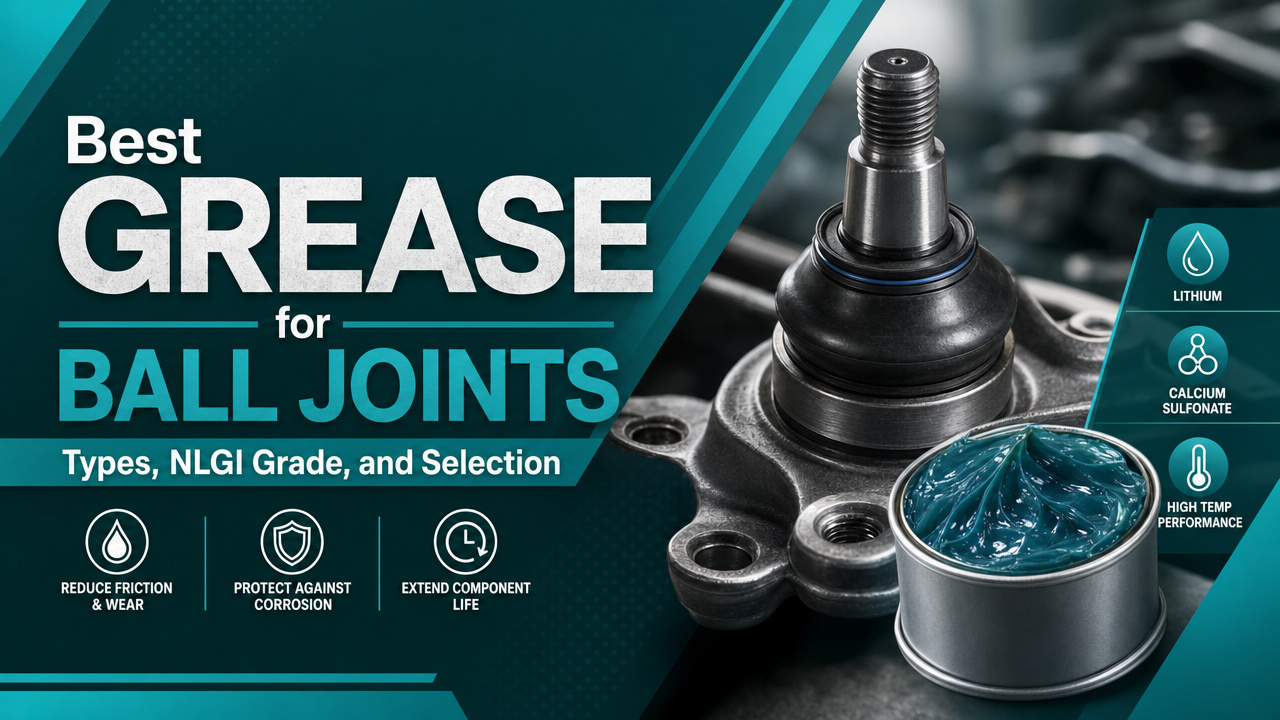
Ball joints operate under constant shock loads, oscillating motion, and metal-to-metal contact. A general-purpose product fails fast here. The right grease for ball joints must resist pounding pressure, retain film strength, and stay in place despite vibration and heat from nearby brake and exhaust components.
Suspension grease also faces water, road salt, and dust intrusion through worn grease boots. Without strong washout resistance and rust protection, the lubricant flushes out and corrosion begins. That's why automotive ball joint grease is engineered with EP additives and tackifiers, not just thickener and base oil.
Ball joints share lubrication needs with tie rod ends, steering knuckles, and king pins. Selecting a proper grease for ball joints means matching base oil viscosity, NLGI grade, and additive chemistry to the load and operating temperature of the chassis.
Lithium complex grease is the workhorse of chassis and suspension grease. It offers a drop point above 260°C, excellent mechanical stability, and strong water resistance. Lithium complex EP 2 with moly is the most widely recommended grease for ball joints in passenger cars and light trucks.
Moly grease for ball joints contains molybdenum disulfide, a solid lubricant that plates onto metal surfaces under high load. It excels where shock loading and sliding friction dominate, such as U-joints, CV joints, and heavy duty ball joint grease applications in 4x4 and off-road vehicles.
Polyurea grease suspension applications are less common in open chassis points. Polyurea offers exceptional oxidation stability and long service life but is typically sealed-for-life in electric motors and bearings. It also has thickener compatibility issues with lithium-based products, so avoid mixing.
Quick comparison of the three:
NLGI 2 grease ball joints applications dominate the market. Grade 2 has the right consistency — firm enough to stay inside grease boots, soft enough to pump easily through a zerk fitting with a standard grease gun.
NLGI grade 2 vs grade 1 comes down to climate. Grade 2 is standard year-round. Grade 1 is softer and used in extreme cold, where Grade 2 becomes too stiff to flow into the joint. Above 0°F, stay with NLGI 2.
Look for the NLGI GC-LB certification mark. GC covers wheel bearings, LB covers chassis lubrication. A GC-LB rated product meets automotive chassis lubricant standards for both wear protection and high-temperature performance.
Moly content in grease varies widely. For ball joints and steering linkage, the sweet spot is 3 percent moly grease. This level provides solid film protection under shock load without risking buildup or seal compatibility issues.
5 percent moly grease is reserved for severe service — U-joints, fifth wheels, heavy duty truck suspension grease, and agriculture equipment ball joint grease. Higher moly is excellent for slow, high-pressure sliding contact but unnecessary for typical passenger car suspension grease.
Avoid grease with no moly listed if you drive a truck, SUV, or off-road vehicle. Pure lithium soap grease without moly handles light duty but lacks the boundary lubrication needed when ball joints take repeated impact loads on rough terrain.
Not every tube on the shelf belongs in a chassis zerk. Some products will degrade seals, wash out fast, or react with existing grease. Here's what to skip:
Avoiding grease incompatibility matters most when changing grease types in suspension. If you switch from lithium to polyurea, purge the old grease completely. Mixing incompatible thickeners turns the lubricant into a liquid or hard paste, killing protection.
Suspension joint grease interval depends on vehicle type, driving conditions, and grease quality. Standard guidance:
Signs a ball joint needs grease include squeaking suspension, clunking over bumps, and dry or cracked grease boots. Don't wait for noise. Preventive lubrication intervals stop premature ball joint failure long before symptoms appear.
How to grease ball joints properly: wipe the zerk fitting clean, attach the grease gun, and pump slowly until fresh grease appears at the boot seal. Stop before the boot balloons. Overgreasing tears the seal and lets contaminants in.
Greasing sealed vs unsealed ball joints differs. Sealed joints have no zerk and are lubricated for life — replace, don't grease. Unsealed joints with zerk fittings need regular service to maintain film thickness and flush out contaminated grease.
For fleet operators and off-road users, Armor Lubricants chassis grease delivers lithium complex EP 2 fortified with 3% moly, meeting NLGI GC-LB and providing extended service interval performance across automotive, heavy duty, and agricultural suspension components.
Choosing the right lubricant for chassis isn't complicated once the criteria are clear: NLGI 2 consistency, lithium complex thickener, EP additives, 3% moly, and GC-LB certification. Match those specs and ball joint life extends well beyond OEM expectations.