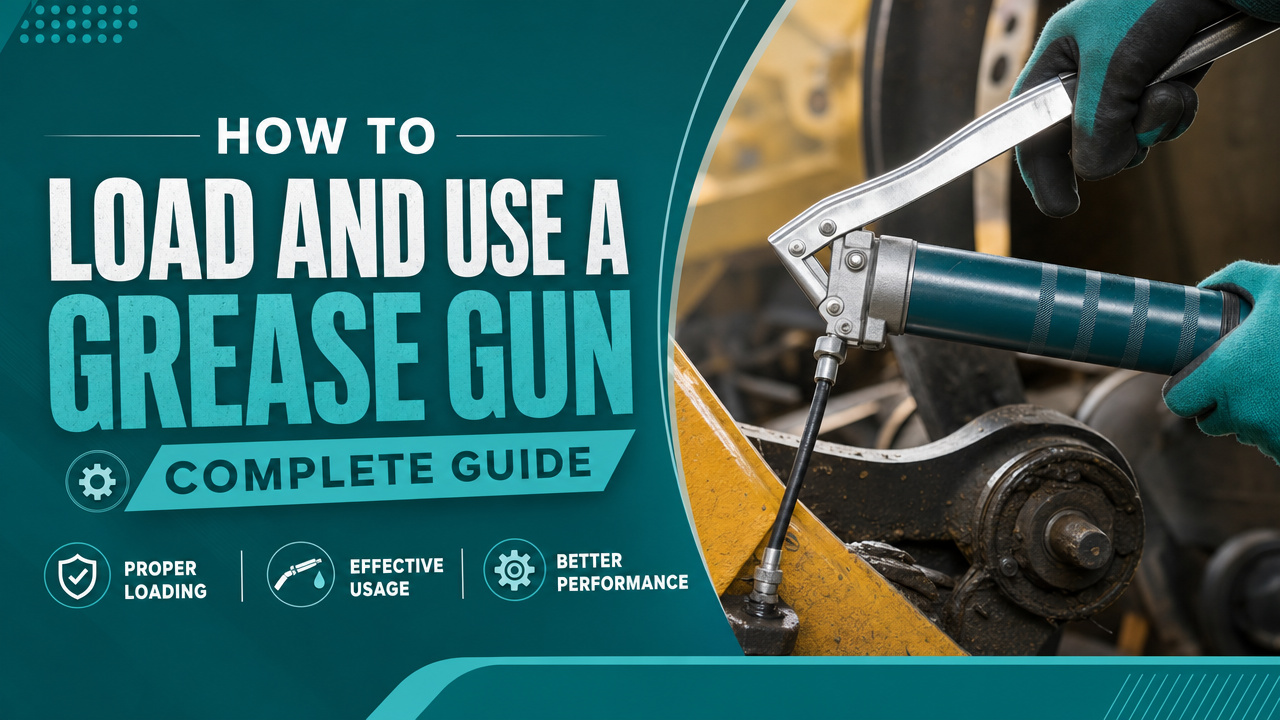
A grease gun is the backbone of any lubrication program, delivering precise amounts of grease to bearings, joints, and fittings. Proper loading and operation directly impact equipment protection, friction reduction, and wear protection across heavy machinery and fleet maintenance operations.
This guide covers cartridge loading, bulk suction fill, priming, and field application. Whether you run a pistol grip grease gun on a job site or a pneumatic unit in a workshop, the fundamentals remain consistent across every industrial greasing task.
Selecting the right tool starts with knowing what each style does best. Each design handles pressure output, portability, and grease volume differently, which affects how you load and operate it.
Heavy duty grease guns typically deliver 10,000 PSI or more, which is necessary for stubborn grease nipples on agricultural machinery and marine applications.
Most grease guns accept a standard 14 oz grease cartridge, which is the fastest and cleanest loading method. Use an NLGI grade 2 grease cartridge for general-purpose work, or switch to a lithium complex grease gun cartridge for high temperature or extreme pressure EP applications.
Follow these steps to load a grease cartridge correctly:
If the gun fails to prime after loading, the most common cause is an air pocket trapped between the follower plate and the grease tube.
A suction fill grease gun draws grease directly from a tub or pail, which is cost-effective for high-volume users buying bulk industrial grease. This method eliminates cartridge waste and works well for manufacturing plant maintenance.
To fill a grease gun via suction:
Keep the barrel submerged throughout the pull to prevent air ingress. Pulling too fast is the leading cause of air locks in suction-filled guns.
Priming pushes grease through the barrel into the coupler so the gun delivers product on the first stroke. A grease gun pumping air instead of grease almost always points to a trapped air pocket near the follower plate.
To prime and bleed air from grease gun:
For a grease gun that won't prime, push the plunger rod forward while pumping the handle. This forces grease past any voids in the tube. Tapping the barrel against your palm also helps dislodge stubborn air pockets.
Zerk fittings, also called grease nipples, are spring-loaded check valves that allow grease in and prevent it from flowing back out. Proper technique ensures the grease reaches the bearing rather than blowing past worn seals.
Before connecting, wipe the zerk fitting clean with a lint-free rag. Dirt forced into a bearing is more damaging than running it dry. For neglected fittings, use a needle scaler or replace the fitting entirely.
If the coupler will not seat, the fitting may be clogged. Clean it or replace it before continuing.
Over greasing bearings causes more failures than under-greasing. Excess grease builds pressure inside sealed bearings, blows out seals, and traps heat. This shortens bearing life and contaminates surrounding components.
Use this formula to calculate grease volume per stroke:
Grease quantity (oz) = 0.114 × bearing OD (inches) × bearing width (inches)
Most manual grease guns deliver roughly 0.5 to 1 gram per stroke, though this varies by model. Test your specific gun by pumping ten strokes onto a scale to calibrate.
General guidelines for proper greasing techniques:
Preventative maintenance lubrication done correctly extends service intervals and reduces unplanned downtime.
A clean, well-maintained grease gun delivers consistent pressure and prevents contamination of your lubricant supply. Neglected guns become a source of bearing failure rather than protection.
Routine maintenance practices:
To store a grease gun properly, release the spring tension by pulling the plunger rod back to its locked notch. This prevents the spring from weakening and stops grease from oozing past the seals. Store horizontally in a clean, dry location away from temperature extremes.
Label each gun with the grease type inside it (lithium complex, polyurea grease, moly grease, or synthetic) to avoid cross-contamination. Mixing incompatible thickeners, such as lithium and polyurea, breaks down both greases and causes premature equipment failure.
For demanding applications across construction, marine, power generation, and manufacturing, Armor Lubricants supplies OEM approved grease formulations engineered for thermal stability, oxidation stability, and anti-rust and corrosion protection. Choosing the right lubricant matters as much as proper greasing technique.